A practical, no-nonsense guide for anyone who wants the real thing — not a machine-made imitation.
The Jamdani saree is one of the greatest treasures of Bangladeshi culture. Recognized by UNESCO as an Intangible Cultural Heritage of Humanity in 2013, it is a fabric woven not just from cotton thread but from centuries of skill, patience, and artistic tradition. A genuine Jamdani can take a master weaver weeks — sometimes months — to complete, and no two pieces are ever exactly alike.
Yet today, the Jamdani market in Bangladesh is flooded with fakes. Machine-printed imitations, power-loom copies, and deceptively labeled synthetic blends are sold openly in markets and even in branded stores. Unsuspecting buyers — including many who have purchased "Jamdani" sarees for years — are often unknowingly buying something far removed from the authentic article.
This guide will teach you everything you need to know to buy a genuine Jamdani saree with confidence: what to look for, where to buy, what to pay, and how to avoid the most common traps.
What Makes a Jamdani Truly Authentic?
Before you can spot a fake, you need to understand what the real thing actually is.
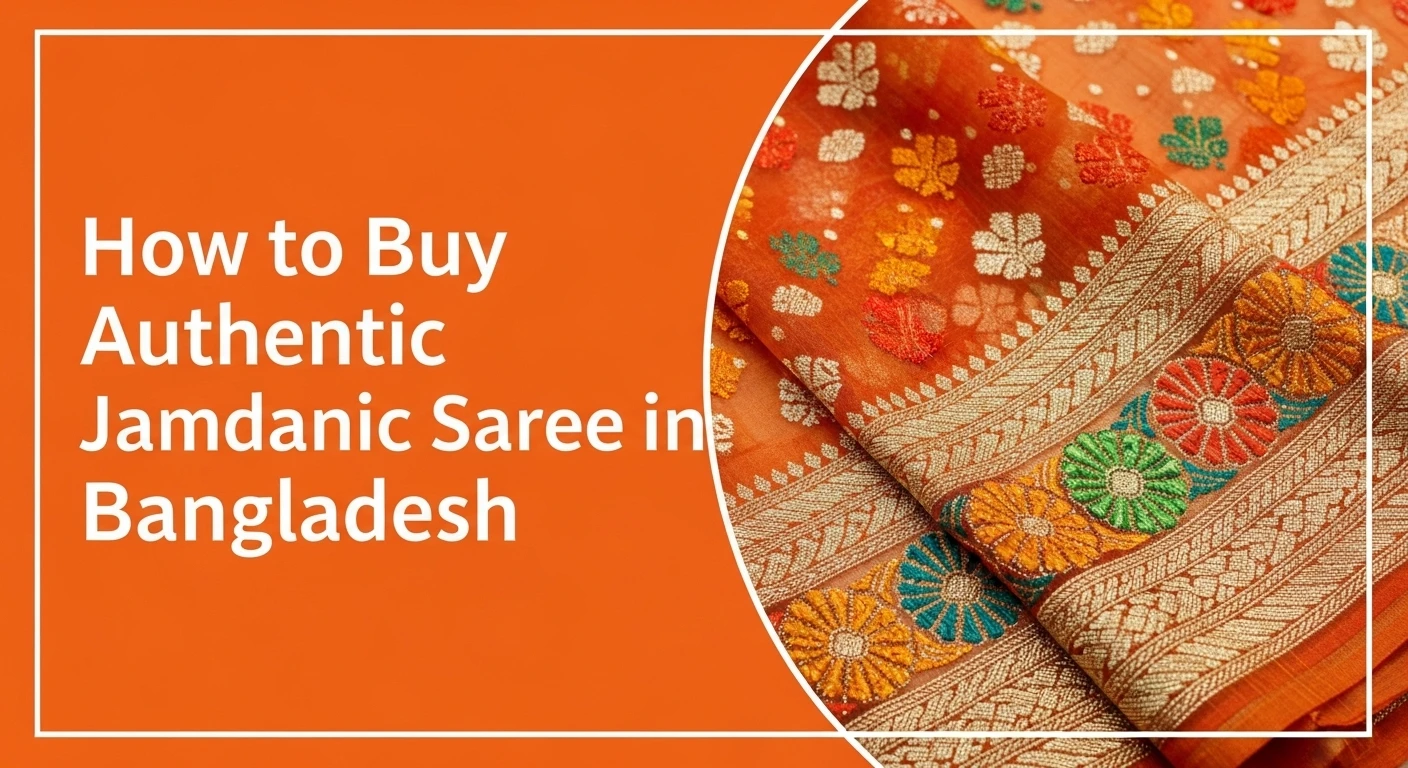
Authentic Jamdani is a handloom fabric, traditionally woven from fine cotton — and historically from the legendary Dhaka muslin, the finest cotton ever produced. The defining characteristic of Jamdani is its supplementary weft technique: the decorative motifs (flowers, geometric patterns, paisleys, vines) are not printed onto the fabric or embroidered on top of it. They are woven directly into the cloth during the weaving process itself, using an additional thread that floats across the base weave to create the pattern.
This means every motif in a genuine Jamdani is structurally part of the fabric. It cannot be washed off, peeled away, or separated from the cloth. The pattern and the fabric are one.
This process is extraordinarily time-consuming. A single saree may require two weavers working together for 15 to 90 days depending on the complexity of the design. This is why genuine Jamdani commands a premium price — and why it is so aggressively counterfeited.
The Different Types of Authentic Jamdani
Not all genuine Jamdani is the same. Understanding the varieties will help you shop more intelligently.
By Fabric Base
Cotton Jamdani is the traditional and most common form. Fine cotton yarn is used for both the base weave and the supplementary weft motifs. This is the everyday Jamdani — breathable, lightweight, and ideal for Bangladesh's warm climate.
Silk Jamdani uses silk yarn for either the base or the motifs (or both), giving the saree a subtle sheen and a slightly richer drape. It is generally more expensive than cotton Jamdani.
Muslin Jamdani is the rarest and most prestigious form, woven from extremely fine muslin-grade cotton that has been revived by government and NGO efforts in recent years. Genuine muslin Jamdani is extraordinarily delicate and can cost BDT 50,000 to several lakhs per piece.
Cotton-Silk Blend Jamdani uses a combination of both fibres — typically silk in the warp (lengthwise threads) and cotton in the weft (crosswise threads). This creates a fabric that combines the breathability of cotton with the luster of silk.
By Design Style
Dhakai Jamdani is the most famous variety, originating in Dhaka and its surrounding areas. It is characterized by delicate, fine motifs — often floral — set against a nearly transparent base cloth.
Tangail Jamdani comes from the Tangail district and tends to have a slightly thicker base weave with bolder, more densely packed patterns. It is more durable and typically less expensive than fine Dhakai Jamdani.
All-Over Jamdani (Jaal Jamdani) features motifs distributed evenly across the entire surface of the saree. These are among the most labor-intensive and prized pieces.
Border Jamdani concentrates the woven motifs along the border and pallu (the decorative end piece), with a plain or lightly decorated body. These are generally less expensive and suitable for everyday wear.
How to Identify Genuine Jamdani: The Key Tests
This is the most important section of this guide. Learn these tests and use them every time you shop.
1. The Light Test (The Most Reliable)
Hold the saree up to a natural light source — ideally bright sunlight or a strong lamp. A genuine fine Jamdani will be semi-transparent, almost translucent. You should be able to see light filtering clearly through the base fabric. The woven motifs will appear as slightly denser areas within this translucent weave.
Machine-printed imitations are almost always opaque — they are made of thicker, cheaper fabric that blocks light completely. If you cannot see light through the base fabric, it is almost certainly not a fine handloom Jamdani.
2. The Motif Reversal Test
Turn the saree over and look at the back of the fabric, particularly in the area of the woven motifs. On a genuine Jamdani, the motif will be clearly visible on both the front and the back of the fabric — because it is woven through the cloth, not applied to the surface. The back may look slightly less polished, with small floating thread tails, but the pattern itself will be unmistakably present.
On a printed imitation, the back will be blank or show only a faint, blurred ghost of the pattern. The print sits on the surface only.
On an embroidered imitation, the back will show embroidery thread work — entirely different from the woven structure of genuine Jamdani.
3. The Thread Count and Fineness Test
Run your fingers along the base fabric between the motifs. Genuine fine Jamdani cotton will feel remarkably smooth and fine — almost like a thin, cool skin against your fingers. The weave will be tight but the individual threads will be very thin.
Coarser imitations or lower-quality machine-made copies will feel thicker, rougher, and less refined to the touch. The difference is noticeable once you have handled a genuine piece.
4. The Price Reality Test
This is arguably the simplest filter of all. Genuine handloom Jamdani cannot be cheap. If a saree is being sold as "authentic Jamdani" for BDT 500, 800, or even 1,500 — it is not authentic Jamdani. Period.
Here is a rough pricing reality check for genuine pieces:
- Entry-level authentic Jamdani (simple border work, basic cotton): BDT 2,500 – 6,000
- Mid-range Jamdani (moderate motif density, good quality cotton): BDT 6,000 – 20,000
- Premium Jamdani (fine cotton, dense all-over work, master weaver): BDT 20,000 – 60,000+
- Museum-quality Muslin Jamdani: BDT 50,000 – several lakhs
If the price seems too good to be true, it is.
5. The Weaver's Thread Tails Test
Examine the edges of the woven motifs on the back of the saree carefully. On a hand-woven Jamdani, you will often find small tails or floats of supplementary thread — the evidence of the weaver's hand at work. These are not defects. They are proof of authenticity. Machine imitations will not have these.
6. The Irregularity Test
Perfection is suspicious in handloom. A genuine hand-woven Jamdani will have very subtle, microscopic irregularities in the weave — slight variations in the spacing of motifs, tiny imperfections in the thread tension. These are the fingerprints of the human hand. If a saree's pattern looks mechanically perfect and absolutely uniform across every centimetre, it was almost certainly made by machine.
Where to Buy Authentic Jamdani in Bangladesh
Knowing what to look for is only half the battle. Where you buy matters enormously.
1. Directly from Weavers — Rupganj and Narayanganj
The best and most authentic Jamdani shopping experience in Bangladesh is to go directly to the source. The Rupganj Upazila in Narayanganj district is the heartland of modern Jamdani weaving. Villages such as Noapara, Tarabo, and Nandalpara are home to hundreds of weaving families who have practiced this craft for generations.
Visiting these villages allows you to watch the weaving process firsthand, speak with the weavers, and purchase directly — cutting out all middlemen and typically getting the best price for a given quality level. Many weavers sell from their homes or through small cooperative setups. Some NGO-supported weaving clusters offer guided visits.
The experience is also genuinely moving. Watching a master weaver work — two people sitting at a wooden loom, hands moving with extraordinary precision to build a pattern thread by thread — gives a Jamdani purchase a meaning that no shop can replicate.
2. Aarong
Aarong is the most trusted retail destination for authentic Jamdani in Bangladesh. As a BRAC enterprise with a long-standing commitment to artisan welfare and authentic craftsmanship, Aarong sources its Jamdani directly from weaving communities and maintains strict quality standards. Their pieces are certified and the staff are generally knowledgeable.
The tradeoff is price — Aarong Jamdanis are priced at a premium that reflects both quality and the fair wages paid to weavers. But for buyers who cannot travel to Rupganj and want absolute confidence in what they are buying, Aarong is the gold standard.
3. Banglar Mela
Banglar Mela is another trusted name in authentic Bangladeshi craft retail, with a focus on handloom and traditional textiles. Their Jamdani selection is carefully curated and the brand prides itself on direct artisan sourcing. A good alternative to Aarong for those seeking variety.
4. Deshal
Deshal is a boutique brand with a genuine passion for Bangladeshi craft heritage. Their Jamdani offerings are typically limited in quantity but high in quality, often featuring contemporary color palettes and modern design sensibilities applied to authentic handloom techniques.
5. Government Craft Fairs and Exhibitions
The Bangladesh Small and Cottage Industries Corporation (BSCIC) and various government agencies regularly organize craft fairs — most notably during Ekushey Boi Mela season, Pohela Boishakh, and Eid. These fairs often feature weaving cooperatives and artisan groups selling directly, offering excellent authenticity and fair pricing.
The annual Jamdani Mela organized in Narayanganj is a particularly valuable event — a dedicated fair where weavers from across the district gather to sell their work. Mark it on your calendar.
6. Online — With Caution
Several reputable online platforms sell authentic Jamdani, including Aarong's own e-commerce store and curated boutiques on Facebook and Instagram. However, online Jamdani shopping carries significant risk because you cannot perform the physical tests described above. Stick to sellers with verifiable track records, genuine customer reviews, and clear return policies. Be very skeptical of low prices.
Where NOT to Buy Jamdani
Being honest about risky shopping destinations is just as important as recommending good ones.
New Market and Mirpur saree markets are known for offering extremely competitive prices on "Jamdani" sarees — but the vast majority of what is sold in these markets as Jamdani is machine-printed or power-loom imitation. Unless you are an expert who can identify fakes on the spot, these are very high-risk shopping environments for authentic Jamdani.
Unverified Facebook and social media sellers — while many legitimate boutiques operate on Facebook, the platform is equally full of sellers offering fake Jamdani at suspiciously low prices with professional-looking photography. Research any seller thoroughly before buying.
Airport shops and tourist-oriented gift stores — these tend to sell decorative items that trade on the Jamdani name without the substance. Rarely worth the price paid.
Understanding the GI Tag — and Why It Is Not Enough
In 2016, Bangladesh received Geographical Indication (GI) certification for Jamdani, legally protecting it as a product of Bangladeshi origin. In principle, this should help authenticate the product. In practice, the GI tag system has not been effectively enforced at the retail level, and fraudulent use of GI labeling is common.
Do not rely on a GI tag alone as proof of authenticity. Use the physical tests described in this guide in addition to — not instead of — any label or certification.
Caring for Your Authentic Jamdani
A genuine Jamdani saree is an investment. Treat it accordingly.
Washing: Hand wash only, in cold water, with a very mild detergent. Never machine wash — the agitation can damage the fine woven structure. Avoid wringing. Gently press out excess water between two clean towels.
Drying: Dry in shade, never in direct sunlight. Prolonged sun exposure can fade the natural cotton fibers and weaken the threads over time.
Ironing: Iron on a low to medium setting, ideally on the reverse side of the fabric. A light spritz of water can help smooth wrinkles without needing high heat.
Storage: Store folded loosely in a clean cotton cloth (not plastic). Avoid sharp folds along the same line repeatedly, as this can cause the fabric to wear at the crease. Store in a cool, dry place away from moisture and insects. Occasional airing is beneficial.
A Note on Price Negotiation
If you are buying directly from weavers, some gentle negotiation is culturally acceptable and expected. However, be mindful that you are negotiating with an artisan who may have spent weeks on a single piece. The labor involved in genuine Jamdani is immense, and deeply undercutting a weaver's asking price undervalues that labor in ways that have real consequences for their livelihood.
A fair deal is one that feels good for both sides. Aim for respect, not just a bargain.
Summary: The Authentic Jamdani Buyer's Checklist
Before purchasing any saree sold as Jamdani, run through this checklist:
- [ ] Does the saree pass the light test — is the base fabric semi-transparent?
- [ ] Is the motif clearly visible on both the front and back of the fabric?
- [ ] Does the fabric feel fine and smooth between the motifs?
- [ ] Are there subtle thread tails or floats on the reverse side of the motifs?
- [ ] Are there microscopic irregularities in the weave that suggest hand production?
- [ ] Is the price consistent with genuine handloom Jamdani (minimum BDT 2,500 for the simplest pieces)?
- [ ] Am I buying from a trusted source — a reputable retailer, weaving cooperative, or verified artisan?
If you can check every box with confidence, you are looking at the real thing.
Final Thoughts
Buying an authentic Jamdani saree is one of the most rewarding experiences available to anyone who loves Bangladeshi culture and craftsmanship. It is a chance to own something that is genuinely irreplaceable — a handmade object of beauty produced through a tradition that has survived for centuries and that continues to evolve in the hands of living artisans.
But that experience is only meaningful if what you are buying is real. The fakes are good enough to fool most people most of the time, and the only reliable defense is knowledge.
Learn the tests. Know the prices. Buy from trusted sources. And when you find the right piece — that Jamdani that catches the light in exactly the right way, that carries a pattern woven by a real person's hands in a village outside Narayanganj — you will know it. And it will be worth every taka.
Prices mentioned are approximate and subject to market variation. For the most current pricing and availability, visit weavers directly or consult trusted retailers such as Aarong and Banglar Mela.
 english




 Automotive
 Gifts & Occasions
 Electronics & Computers
 Fashion & Apparel
 Beauty & Personal Care
 Home & Lifestyle
 Sports & Fitness
 Books, Movies & Music
 Baby & Kids