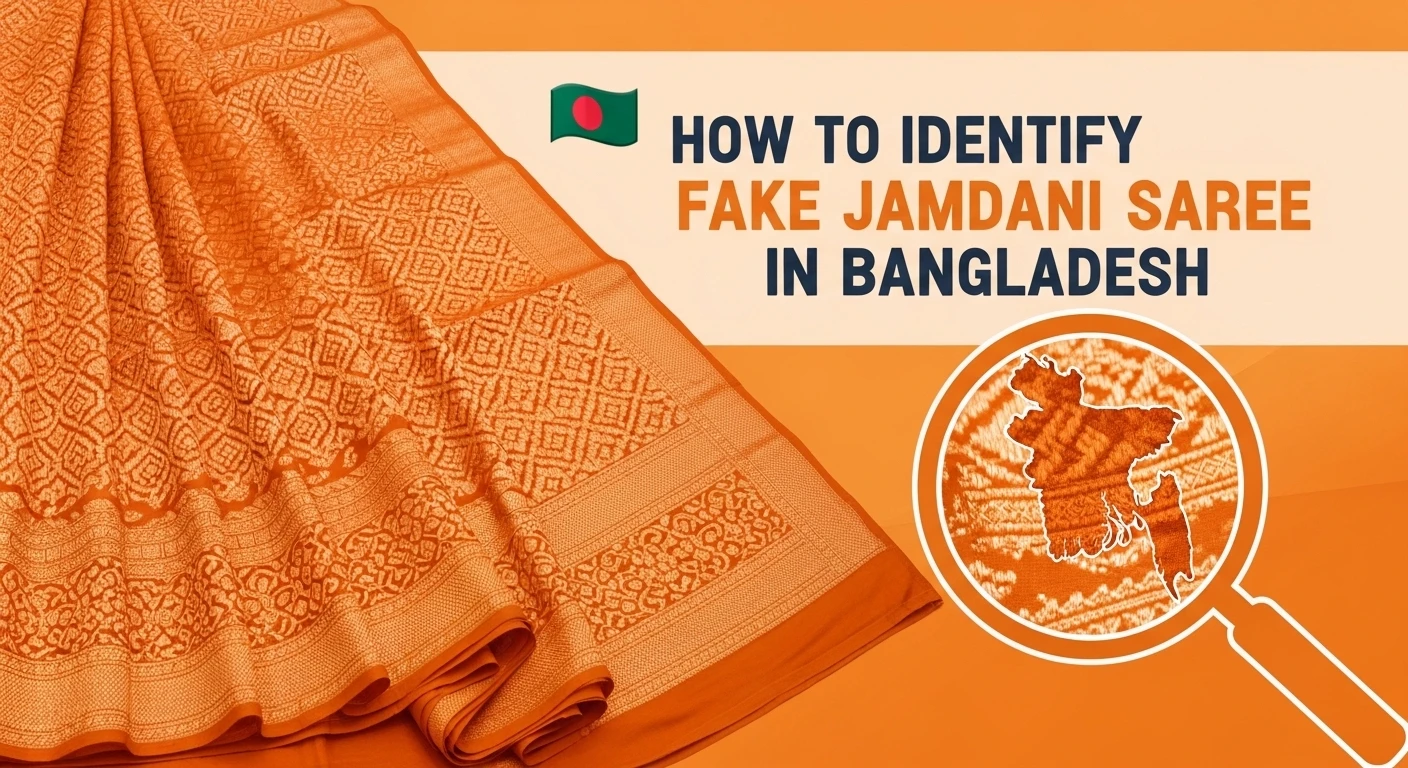
A no-nonsense, hands-on guide to spotting imitations before your money leaves your hand.
Walk into almost any saree market in Bangladesh and you will find dozens of stalls confidently selling "authentic Jamdani." The labels say Jamdani. The sellers say Jamdani. The price — suspiciously low — says something else entirely.
The uncomfortable truth is that the majority of sarees sold as Jamdani in Bangladesh's general retail market are not authentic handloom Jamdani. They are machine-printed imitations, power-loom copies, or synthetic blends that exploit the name and reputation of one of the country's most celebrated cultural treasures. Estimates from weaving cooperatives and craft researchers suggest that for every genuine handloom Jamdani sold in Bangladesh, several dozen fakes change hands under the same name.
The fakes have become extraordinarily convincing. Modern printing technology can replicate the visual appearance of Jamdani motifs with impressive accuracy. A machine-made copy displayed on a shop shelf, under artificial light, folded neatly — it can fool even experienced buyers. Once you are home and the money is spent, there is no recourse.
The only reliable defense is knowledge. This guide will give you every tool you need to identify a fake Jamdani saree on the spot, before you buy.
Why Fakes Are So Widespread
Understanding why the fake Jamdani problem exists at this scale helps you understand who is selling them and why.
Genuine handloom Jamdani is extraordinarily labor-intensive. A single saree requires two skilled weavers working together for anywhere between two weeks and three months, depending on the complexity of the design. The cost of that labor, plus quality raw materials, means an authentic piece cannot be produced cheaply. A genuine entry-level Jamdani costs a minimum of BDT 2,500–3,000 to produce — and premium pieces cost far more.
Machine-printed imitations can be produced in minutes and cost a fraction of that. The profit margin on a fake Jamdani sold at BDT 800–1,200 as "authentic" is enormous. With limited consumer awareness, inconsistent enforcement of GI (Geographical Indication) protections, and a market that has trained buyers to expect low prices, the incentive to sell fakes is very high and the risk very low.
This is not always straightforward fraud. Some sellers genuinely do not know the difference. Some use the word "Jamdani" loosely to describe any saree with floral motifs, regardless of how it was made. But the result for the buyer is the same — you pay for something you did not receive.
The Six Types of Fake Jamdani You Will Encounter
Not all fakes are the same. Knowing the different categories of imitation helps you understand what you are looking at.
Type 1: Screen-Printed or Digital-Printed Imitations
The most common fake. The Jamdani motif pattern is printed directly onto the surface of the fabric using screen printing or digital printing technology. The fabric itself is often a cheap cotton or synthetic blend. These are the easiest fakes to identify once you know what to look for, but they can be visually convincing from a distance.
Type 2: Power-Loom Woven Copies
A more sophisticated imitation. The saree is woven on a power loom — an industrial machine — rather than a handloom. The motifs are woven into the fabric rather than printed on top of it, which makes this type harder to detect than a simple print. The weave structure may appear similar to genuine Jamdani at first glance. However, machine-woven copies lack the fine irregularities, translucency, and structural character of true handloom work.
Type 3: Embroidered Imitations
The motifs are embroidered onto a plain base fabric rather than woven into it. These are usually easy to identify by examining the back of the saree, but some sellers actively prevent buyers from examining the back, which should itself raise suspicion.
Type 4: Hybrid or Half-Handloom Pieces
Some pieces are partially handloom — the base fabric may be genuinely woven on a handloom, but the decorative motifs are added later by machine printing or machine embroidery rather than being woven in during the original process. These are sold as "handloom sarees" which is technically partially true but deliberately misleading when presented as Jamdani.
Type 5: Synthetic Fiber Imitations
A completely different fabric — polyester, viscose, or synthetic blends — is used to produce a saree that resembles Jamdani in color and pattern but is nothing of the kind. These are the lowest-quality fakes and are usually identifiable by touch, sheen, and the light test.
Type 6: Tangail or Other Handloom Sarees Mislabeled as Jamdani
Not always malicious — sometimes a Tangail cotton saree with decorative motifs is sold or described as Jamdani simply because the seller does not know the distinction or because "Jamdani" has become a loose commercial term for any decorated handloom saree. These pieces may be perfectly good sarees in their own right, but they are not Jamdani, and you should not pay Jamdani prices for them.
The Tests: How to Identify a Fake Jamdani
These are the physical tests you can perform in the shop, before purchasing. Use as many as possible. No single test is completely definitive — the combination of multiple tests gives you the most reliable result.
Test 1: The Transmitted Light Test
This is the single most reliable test for fine Jamdani and should always be your first.
Pick up the saree and hold a section of the body fabric — away from the border and away from the decorative motifs — up to a strong light source. Natural sunlight is best. A bright shop light will do if sunlight is unavailable.
What genuine Jamdani looks like: The base fabric will be semi-transparent to nearly translucent. Light will pass through the fine cotton weave clearly. You will be able to see your hand or fingers through the fabric, or at minimum see light filtering visibly through. The woven motifs will appear as slightly denser, slightly less transparent areas within this luminous base.
What a fake looks like: Machine-printed copies are made on opaque fabric. Hold them up to the light and you will see little to no light transmission. The fabric blocks the light. This is because cheap cotton or synthetic base fabrics used in printed imitations are far thicker and denser than the fine muslin-grade cotton used in authentic Jamdani.
Important nuance: Not all genuine Jamdani is ultra-fine. Tangail Jamdani and certain everyday-quality pieces use a slightly thicker cotton base and will be less translucent than fine Dhakai Jamdani. But even these should show some light transmission. Completely opaque fabric at any quality level is not genuine fine Jamdani.
Test 2: The Reverse Side Motif Test
This test distinguishes woven motifs from printed or embroidered ones.
Ask to see the back of the saree — specifically in the area of the decorative motifs. Any legitimate seller should allow this without hesitation. If a seller resists or makes it difficult for you to examine the back, treat this as a significant red flag.
What genuine Jamdani looks like on the back: The woven motif will be clearly visible on the reverse side of the fabric because it is structurally part of the cloth. The back of a genuine Jamdani motif will show small floating threads — supplementary weft threads that travel across the back of the fabric between one motif element and the next. These floats are a direct signature of the supplementary weft weaving technique. They are not a defect. They are proof.
The back will not look as clean or finished as the front — the motif may appear slightly less crisp on the reverse — but it will unmistakably be there.
What a printed fake looks like on the back: Blank. Or at most, a very faint, slightly blurred ghost of the surface print. The print sits on the surface only and does not penetrate the weave structure of the cloth.
What an embroidered fake looks like on the back: Embroidery thread work — a dense mass of stitching that looks completely different from the fabric structure of the front. Sometimes deliberately hidden by a lining or backing fabric added to conceal it.
Test 3: The Touch and Fineness Test
This test evaluates fabric quality and fiber type.
Run your fingers across the base fabric of the saree — the plain sections between the decorative motifs. Move your fingertips slowly across the surface, paying attention to texture, weight, and temperature.
What genuine fine Jamdani feels like: Remarkably smooth and cool. The threads are so fine that the fabric has an almost skin-like quality — it lies against your fingers without resistance, feels lightweight, and has a subtle natural softness. It does not feel slippery or plasticky. Quality cotton Jamdani feels alive under your fingers in a way that synthetic fabric simply does not.
What a synthetic fake feels like: Slightly warm or neutral in temperature (synthetic fabrics do not conduct heat the way natural cotton does), with a smooth but slightly artificial slip to the surface. If you press the fabric between your fingers and then release it, synthetic fabric tends to spring back with less natural drape. Some synthetic blends have a subtle artificial sheen that looks different from the gentle natural luster of quality cotton.
What a cheap cotton fake feels like: Coarser and heavier than genuine fine Jamdani. The weave will feel less refined under your fingertips — you may actually feel individual threads more distinctly, which is a sign of thicker, lower-quality yarn.
Test 4: The Thread Float Examination
A close inspection that confirms hand-weaving.
This test builds on the reverse side test but goes into more detail. On the reverse of the saree, examine the supplementary weft floats — the small threads that travel across the back of the fabric between design elements — as closely as possible. Use your phone camera in macro mode if necessary; the detail can be difficult to see with the naked eye in poor light.
What genuine hand-woven Jamdani shows: The floats will be actual individual threads or small bundles of thread lying loosely across the back of the fabric. They will be consistent with the thread used in the motif itself. At the beginning and end of each design element, there may be tiny thread tails — the evidence of where the weaver's supplementary thread began and ended that section of the motif.
What a power-loom copy shows: A power-loom woven copy may also have floats on the back, but they will appear mechanical and uniform — perfectly consistent in length, perfectly regular in spacing. The human hand introduces micro-variation that machines do not. If the floats look too regular, too consistent, too perfect — they were made by a machine.
Test 5: The Price Plausibility Test
The most underused but most immediately available test.
Before you pick up a single saree, look at the price tag. If a saree is being sold as "authentic Jamdani" at BDT 500, 700, 900, or 1,200 — you are already looking at a fake. Genuine handloom Jamdani cannot be produced at these prices. The raw material and labor costs alone make it impossible.
Here is the honest price floor for genuine handloom Jamdani in Bangladesh:
- Very simple border work, basic cotton, minimal motif density: BDT 2,500 – 4,000 minimum
- Moderate quality, reasonable motif coverage: BDT 5,000 – 15,000
- Good quality, denser patterns, finer cotton: BDT 15,000 – 40,000
- Premium, master weaver, all-over jaal design: BDT 40,000 – 80,000+
- Fine muslin Jamdani: BDT 50,000 to several lakhs
If the price is below these floors, it is not genuine. This is not negotiable — you cannot find a legitimate exception. A seller who claims their BDT 800 saree is "real Jamdani but cheap because I know the weaver personally" is either misinformed or deliberately deceiving you.
Use price as your first, fastest filter. It will save you a great deal of time and examination.
Test 6: The Weave Irregularity Test
This test requires a close look at the overall weave structure.
Step back slightly and look at the body of the saree — particularly the plain sections — in good light. Then look more closely at the decorative motifs and the transition between the base weave and the supplementary weft.
What genuine handloom work shows: Very subtle, microscopic variations in the weave. The spacing between threads will not be absolutely mechanically perfect. Motifs may be very slightly asymmetrical between one repeat and the next. The transitions between the base weave and the decorative thread work will have tiny, almost imperceptible variations. These are not flaws — they are the fingerprints of the human hand, the inevitable and beautiful evidence of a person sitting at a loom building this fabric thread by thread over many days.
What machine production shows: Mechanical perfection. Every repeat of the motif will be absolutely identical — identical size, identical spacing, identical thread tension. The transitions will be perfectly clean and consistent throughout the entire saree. If the pattern looks as regular as a printed wallpaper or a computer-generated design, it was made by a machine.
Test 7: The Drape and Weight Test
A supplementary test that takes practice to calibrate but is useful once learned.
Gather a handful of the saree loosely and let it fall from your hand. Watch how the fabric moves and settles.
Genuine fine cotton Jamdani: Falls and drapes with a fluid, natural quality. It has weight without stiffness — the drape is soft and the fabric moves in organic folds. It does not crinkle harshly or hold rigid creases.
Synthetic fakes: Often have either a stiff, papery quality or an overly fluid, slippery drape that looks artificial. Polyester blends tend to crinkle more sharply and hold crease lines more rigidly.
Printed cotton fakes: The drape may feel similar to genuine cotton, which is why this test alone is insufficient. But in combination with the light test and reverse side test, it adds to the overall picture.
Test 8: The Seller and Source Test
Context and behavior are part of the evidence.
Where you are buying and how the seller behaves are genuine diagnostic data.
Signs of a trustworthy seller:
- Allows you to examine the back of the saree without hesitation
- Can tell you which upazila or weaving cluster the saree came from
- Prices are consistent with genuine handloom production costs
- Does not pressure you or create urgency
- Can explain the difference between handloom and power-loom when asked
- Ideally, has direct relationships with weavers or is a certified cooperative or established boutique
Signs of a suspicious seller:
- Resists or discourages examination of the reverse side
- Cannot or will not say where the saree was made
- Prices are far below the handloom production floor
- Uses very aggressive sales techniques or emotional pressure
- Describes every saree as "special," "rare," or "just arrived from the weaver" regardless of the piece
- Location is a general market with no specialist reputation for handloom
The Comparison: Genuine vs Fake at a Glance
| What You're Testing Genuine Handloom Jamdani Fake / Imitation |
| Light transmission | Semi-transparent to translucent | Opaque or near-opaque |
| Reverse side motif | Clearly visible, thread floats present | Blank, blurred, or embroidery stitching |
| Fabric feel | Fine, cool, smooth, natural | Rough, warm, slippery, or stiff |
| Thread floats | Present, slightly irregular | Absent or mechanically uniform |
| Price | BDT 2,500 minimum | BDT 500–1,500 |
| Motif regularity | Subtle human variation | Mechanically perfect repetition |
| Drape | Fluid, soft, natural | Stiff, slippery, or artificial |
| Seller behavior | Open, informative, not pressuring | Evasive, pushy, avoids scrutiny |
Common Traps and How to Avoid Them
The "Direct from Weaver" Claim
One of the most common sales techniques used in markets is the claim that the saree comes "directly from a weaver I know personally" — implying authenticity and cutting out middlemen. This claim is almost impossible to verify in a market setting and is used routinely to sell fakes. A genuine claim of direct weaver sourcing should be backed by a specific location, preferably a known weaving village like Rupganj or Noapara, and the price should still reflect genuine production costs.
The GI Tag Deception
Bangladesh received Geographical Indication (GI) certification for Jamdani in 2016. Some sellers display this certification visibly to imply their products are certified authentic. The reality is that GI tag enforcement at the retail level is extremely weak. A GI tag on a shop wall or even on a label does not guarantee the specific saree you are holding is authentic handloom Jamdani. Use the physical tests regardless of any labels or certifications.
The "Eid Special" Pressure
During Eid season, markets operate at intense pace, sellers are under pressure to move stock, and buyers are often in a rush. This environment is exactly where fakes sell most easily — when buyers are hurrying, not examining, and feeling social pressure to complete purchases quickly. Deliberately slow down during Eid saree shopping. Take your time. A seller who makes you feel that careful examination is somehow rude or unreasonable is not a seller to trust.
The Artificial Light Trap
Many shops are lit with warm, yellow artificial lighting that makes all fabrics look richer, softer, and more translucent than they are. The light test requires natural or bright white light to be reliable. If possible, carry the saree to a doorway or window where natural light is available before performing the transmitted light test.
The "Premium Machine-Made" Justification
Some sellers, when caught selling power-loom copies, pivot to arguing that their sarees are "high-quality machine-made Jamdani" and that machine-made is not inferior — just different. There is nothing wrong with buying a quality machine-made saree. But it should be sold honestly, for a machine-made price, and not as handloom Jamdani. Do not let this reframing convince you to pay handloom prices for machine production.
Where Fakes Are Most Commonly Found
Being direct about market locations is more useful than vague warnings.
High-risk locations for fake Jamdani:
- New Market, Dhaka (large volume, mixed quality, high fake density)
- Mirpur saree markets (same issue)
- General wholesale fabric markets
- Unverified online sellers on Facebook and social media
- Tourist-facing gift shops and airport outlets
Lower-risk locations:
- Rupganj and Narayanganj — buying directly from weaving households
- Aarong (certified sourcing, established quality standards)
- Banglar Mela (artisan-focused retail)
- Deshal (boutique, curated)
- Government-organized craft fairs and Jamdani Mela in Narayanganj
- BSCIC-certified weaving cooperatives
Buying from a lower-risk location does not mean abandoning the physical tests entirely — but it does dramatically reduce the probability of encountering fakes.
A Note on Educating Yourself Over Time
Reading this guide is a start. But the ability to confidently distinguish genuine Jamdani from fakes is ultimately a tactile, experiential skill that improves with practice.
The best thing you can do is handle a confirmed genuine piece. Visit Aarong or a weaving cooperative in Rupganj and spend time handling authentic Jamdani — examine the back, hold it to the light, feel the fabric. Once your hands and eyes have calibrated against the real thing, returning to a general market and identifying fakes becomes far easier. The difference, once felt, is obvious.
Bring a friend who is an experienced saree buyer when you shop for significant pieces. A second opinion from someone who has handled a lot of genuine handloom sarees is valuable, especially while you are still developing your own knowledge.
Final Thought: The Fake Jamdani Problem Is Fixable
The scale of Jamdani counterfeiting in Bangladesh is genuinely damaging — to the weavers of Rupganj and Narayanganj who cannot compete with fake pricing, to the cultural heritage that gets diluted every time someone buys a machine print under the Jamdani name, and to buyers who pay for something they do not receive.
But the problem is fixable, one informed buyer at a time. When buyers know the difference and refuse to pay handloom prices for machine-made goods, the economics of faking shift. Demand for authentic pieces sustains the weaving communities that keep this extraordinary craft alive.
Learning to identify a fake Jamdani is not just a consumer skill. It is a small act of cultural stewardship.
Related reading: How to Buy Authentic Jamdani Saree in Bangladesh — a companion guide covering where to buy, pricing, and the full buyer's checklist.
 english




 Automotive
 Gifts & Occasions
 Electronics & Computers
 Fashion & Apparel
 Beauty & Personal Care
 Home & Lifestyle
 Sports & Fitness
 Books, Movies & Music
 Baby & Kids