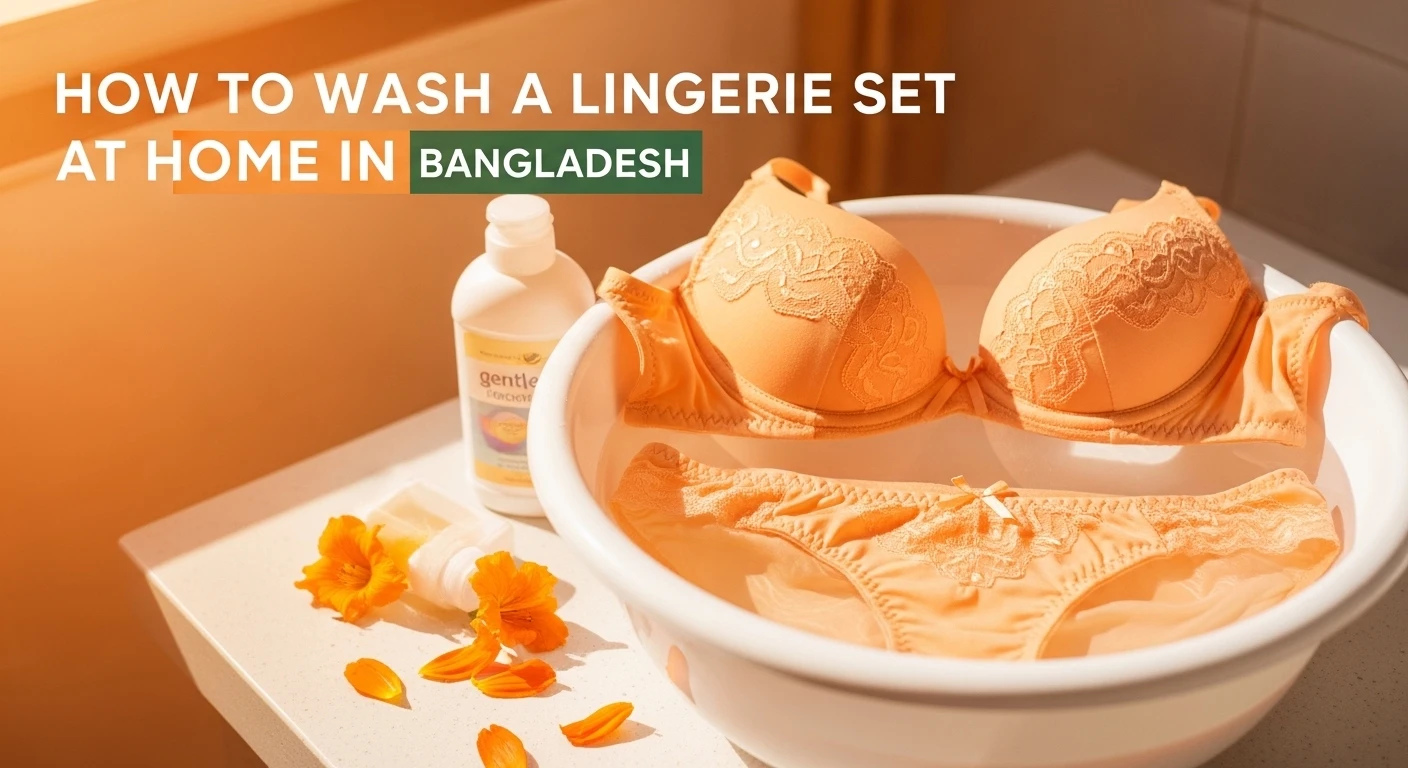
A complete, practical guide to washing every type of lingerie correctly at home — protecting fabric, colour, elasticity, and shape through Bangladesh's challenging climate and seasons.
Most lingerie is ruined not by wear but by washing. The lace that scratches after a few months. The push-up cups that collapse and never recover. The elastic that goes hard and loses its stretch. The silk that shrinks and loses its lustre. The colour that fades from rich burgundy to dull mauve within a season. Almost every one of these outcomes is caused not by poor quality — though that plays a role — but by incorrect washing.
In Bangladesh, the washing challenge has additional dimensions. The climate — hot and humid for most of the year, with a monsoon season that makes everything difficult to dry — creates specific problems for lingerie care that generic washing guides do not address. The hard water in many parts of the country affects detergent performance. The absence of tumble dryers in most Bangladeshi homes means drying technique matters enormously.
This guide covers everything: how to hand wash every type of lingerie correctly, which detergents to use and avoid, how to handle drying in Bangladesh's climate, how to manage the monsoon season specifically, and how to maintain colour, fabric quality, and shape through hundreds of washes. Follow this guidance and your lingerie will last years longer than it otherwise would.
To browse quality lingerie worth caring for properly, explore the Alipeak lingerie collection — one of Bangladesh's most comprehensive online lingerie destinations.
The Fundamental Rule: Machine Washing Destroys Lingerie
Before anything else, this point must be made clearly: machine washing is the single most destructive thing you can do to quality lingerie.
This is not a matter of preference or caution. It is a matter of mechanics. Washing machines — even on delicate cycles, even with lingerie bags — subject fabrics to mechanical agitation, centrifugal force during spinning, and heat that delicate lingerie fabrics are not designed to withstand.
What machine washing does to lingerie specifically:
To underwire bras: The spin cycle bends and distorts underwires. A wire that has been through a machine wash may not immediately appear damaged, but it has been stressed at the bend points. Within a few more washes, it will begin to poke through the casing. The cup structure is also crushed during the spin cycle and may not fully recover.
To push-up padding: The foam padding in push-up bras is permanently compressed by the mechanical agitation and spin of a machine wash. After several machine washes, the padding no longer springs back — the cups lose their shape and the push-up effect is gone. For everything that makes push-up construction good or poor, see our Best Push-Up Bra Set in Bangladesh: Top Picks guide — and understand that none of that quality survives machine washing.
To lace: Machine agitation catches lace on itself and on other garments, causing pulls, tears, and structural damage to the lace pattern. Fine lace that goes through a machine wash repeatedly will look visibly degraded within weeks.
To elastic: The combination of heat and mechanical stress accelerates elastic degradation significantly. Elastic that might last two years with hand washing fails within months in a machine.
To silk: Machine washing silk is a near-certain path to irreversible damage — shrinkage, loss of lustre, weakened fibers that pill and break. Never machine wash silk lingerie under any circumstances.
To colour: The agitation of machine washing causes far more dye to be released with each wash than hand washing does, accelerating colour fading significantly.
The exception — for plain cotton briefs without elastic trim, lace overlay, or delicate construction — machine washing on a cold delicate cycle with a gentle detergent is acceptable as a last resort. For everything else, hand washing is not optional.
What You Need Before You Start
Setting up correctly before washing saves time and produces better results.
The Right Basin or Sink
A clean sink or large basin — big enough to submerge the garment fully without crowding. Washing multiple pieces in the same water is fine if the colours are similar (wash dark and bright colours separately from light ones to prevent dye transfer). Washing too many pieces together reduces water circulation and produces a less thorough clean.
Water Temperature
Cool to lukewarm — never hot.
This is the single most important temperature rule. Hot water causes multiple types of damage simultaneously: it opens fabric fibers and releases dye (causing colour fading), it shrinks natural fibers including cotton and silk, it degrades elastic faster, and it weakens the adhesive bonds in padded cup construction.
Cool water — approximately room temperature in Bangladesh, which is already warm enough — is ideal for most lingerie. For silk specifically, use the coolest water available.
The common instinct to use warm or hot water because it feels more "thorough" is incorrect. Detergent works effectively in cool water. The cleaning is in the detergent, not the temperature.
The Right Detergent
This matters more than most people realize. The wrong detergent damages fabric, destroys colour, and degrades elastic even at cool temperatures.
Use: A gentle, pH-neutral detergent specifically designed for delicates or lingerie. Several options are available in Bangladesh:
- Dedicated lingerie wash products (available at quality lingerie retailers and pharmacies)
- Baby shampoo or mild baby wash — pH-neutral, gentle, and widely available
- A small amount of mild dishwashing liquid (clear, uncolored, unscented) — not ideal but acceptable for non-silk pieces
- Specific delicate fabric detergents from brands like Genteel (widely available in Bangladesh)
Avoid:
- Standard laundry powder or liquid — these contain bleaching agents and optical brighteners that strip colour and weaken delicate fibers
- Biological or enzyme-based detergents — the enzymes that break down stains also attack protein fibers, including silk and wool-blend lace
- Fabric conditioners/softeners on bras — fabric conditioner coats elastic fibers and reduces their elasticity over time, causing premature stretch loss
- Bleach or bleach-containing products — causes immediate and irreversible damage to delicate fabrics and destroys colour
- Detergents with optical brighteners — these are fine for white cotton but cause visible colour changes in dark and bright lingerie colours
How much detergent: Use less than you think you need. A small basin of water with a few drops of delicate wash — roughly half a teaspoon — is sufficient for one or two pieces. Excess detergent is difficult to rinse out completely and leaves residue that stiffens fabric and can cause skin irritation.
A Clean Towel
For the drying step. Have a clean, light-coloured towel ready before you begin washing.
The Hand Washing Process: Step by Step
Step 1: Sort by Colour
Wash dark and bright colours separately from light colours. This is particularly important for the first few washes of any new piece — new lingerie, particularly in deep jewel tones (burgundy, emerald, navy), can release significant dye in the first wash. Washing a new burgundy lace set with an ivory chemise in the same water will leave the chemise pink.
Group wash: dark colours (black, navy, burgundy, emerald) together. Light colours (ivory, blush, white, nude) together. Mid-tones (terracotta, dusty rose, lavender) can go with either group depending on colour intensity.
For everything about which colours are trending and why they matter in lingerie, see our Trending Lingerie Colours in Bangladesh 2026 guide.
Step 2: Pre-Treat Any Stains
If there are any stains, treat them before washing. Apply a tiny amount of gentle detergent directly to the stain and work it in very gently with a fingertip. Do not rub — rubbing damages fibers and can spread the stain. Allow the detergent to sit on the stain for two to three minutes before washing.
For silk specifically: do not pre-treat stains with anything other than cool water and a minimal amount of silk-specific detergent. Silk is extremely sensitive to concentrated chemicals.
Step 3: Fill the Basin with Cool Water
Fill the basin with enough cool water to submerge the garment(s) fully. Add the detergent and swirl to distribute it before adding the lingerie.
Step 4: Submerge and Soak
Place the lingerie in the water and submerge fully. Allow to soak for three to five minutes. This allows the detergent to penetrate the fabric and begin loosening any body oils, perspiration, or residue.
Do not skip this soaking step — it does more of the cleaning work than the actual washing motion, and it allows the fabric to be cleaned without aggressive mechanical action.
Step 5: Gentle Agitation
After soaking, gently move the garment through the water. Squeeze water through the fabric gently and repeatedly. Pay attention to the gusset area of briefs and bodysuits, the underband of bras, and any area that contacts the body most closely — these areas accumulate the most residue and benefit from slightly more attention.
What not to do:
- Do not rub fabric against itself — this damages fibers and causes pilling, particularly in lace
- Do not twist or wring — this distorts shape and stresses seams
- Do not scrub with a brush — too aggressive for all delicate fabrics
- For padded cup bras: squeeze water gently through the cups, never compress or twist them
Total washing time: two to four minutes of gentle agitation is sufficient. Longer is not better.
Step 6: Rinse Thoroughly
Drain the soapy water. Refill the basin with fresh cool water and submerge the garment. Squeeze water gently through the fabric to rinse. Drain and repeat until the water runs clear and there are no visible suds.
Thorough rinsing is important. Detergent residue left in fabric after washing stiffens the fabric when dry, can cause skin irritation against sensitive areas, and gradually degrades elastic.
Typically two to three rinse cycles are sufficient. For pieces with thick padding (push-up bras) or multiple fabric layers (bodysuits, structured bras), do an extra rinse cycle to ensure all detergent has been removed from inside the padding.
Step 7: Remove Excess Water
Do not wring. Instead:
For most pieces: Gently press the garment against the side of the basin to squeeze out excess water. Lift out and hold over the basin, allowing water to drip for thirty seconds.
For bras with padded cups: Hold the bra by the band and allow water to drip from the cups. Gently press each cup between your palms — never twist. The cups should be squeezed flat momentarily and allowed to spring back to their shape.
For silk and satin: Handle very gently — wet silk is particularly fragile. Do not press hard against the basin side.
The towel roll method: Lay the garment flat on a clean dry towel. Fold the towel over the garment. Roll the towel and garment together gently into a cylinder and press lightly — do not twist. Unroll and the garment will have lost most of its remaining moisture. This is the gentlest and most effective method of removing excess water from delicate pieces.
Fabric-Specific Washing Notes
Washing Cotton Lingerie
Cotton is the most forgiving lingerie fabric to wash. It tolerates a slightly wider temperature range (cool to lukewarm), responds well to most gentle detergents, and is relatively resistant to mechanical damage.
Key concerns for cotton lingerie:
- Avoid hot water — cotton shrinks in heat, and lingerie that has been washed in hot water repeatedly will gradually tighten and distort
- Avoid vigorous rubbing — cotton briefs can pill if rubbed aggressively against themselves
- Check the gusset area especially — this area accumulates the most residue and needs thorough but gentle attention
Gusset washing: The cotton gusset of a quality brief should be washed with specific attention. Gently squeeze detergent water through the gusset and rinse thoroughly. The gusset should be odour-free and clean after washing — if it is not, soak for longer or add a tiny additional amount of detergent to this area before the next wash.
For guidance on why a cotton gusset is non-negotiable in quality briefs and bodysuits, see our Best Bodysuit Lingerie in Bangladesh 2026 guide.
Washing Lace Lingerie
Lace is the most fragile of all common lingerie fabrics. Its open structure is beautiful but catches on itself and on other surfaces easily.
Key rules for lace:
- Wash lace pieces alone or with similarly smooth pieces — never with anything that has hooks, rough textures, or decorative hardware that could catch the lace
- Close all hooks and eye closures before washing — open hooks are the primary cause of lace snagging during washing
- Use the gentlest possible agitation — squeeze water through the lace rather than any rubbing motion
- Soak for slightly longer — four to five minutes — to allow water and detergent to penetrate the open lace structure fully
Inspecting lace after washing: Before drying, gently lay the lace flat on a clean towel and inspect the pattern while wet. Wet lace is easier to gently coax back into its correct pattern if any areas have distorted slightly during washing.
Washing Silk Lingerie
Silk requires the most careful approach of any lingerie fabric. It is strong when dry but noticeably more fragile when wet, and it is sensitive to temperature, pH, and mechanical stress in ways that other fabrics are not.
For a complete, detailed guide to washing, drying, and storing silk lingerie — covering everything from detergent pH to ironing technique — our Best Silk Lingerie Set in Bangladesh: Premium Picks guide covers silk care in full. The essential rules:
- Use only the coolest water available — cold from the tap is ideal
- Use only a silk-specific or pH-neutral detergent (regular detergent is alkaline and damages silk protein fibers)
- Minimal soaking time — two minutes maximum
- Zero rubbing — only gentle squeeze-and-release motion
- Never wring silk under any circumstances — the twisting motion permanently damages the woven structure
- Rinse until absolutely no detergent remains — detergent residue causes silk to stiffen and lose its drape
Washing Push-Up Bras
Push-up bras require the most careful physical handling because of the structured cup and padding construction.
Critical rules:
- Never compress or twist the cups during washing or wringing
- Squeeze water through the padding gently — do not press it flat and hold it compressed
- After removing excess water, reshape each cup immediately while the bra is still wet — press the cup back to its correct rounded shape and allow it to dry in that position
- If the padding has become slightly misshapen during washing, gently ease it back to shape while wet — this is much easier to correct wet than dry
For everything about push-up construction quality and why proper washing is essential to maintaining it, see our Best Push-Up Bra Set in Bangladesh: Top Picks guide.
Washing Satin and Microfibre
Satin — whether genuine silk satin or polyester satin — and microfibre both wash relatively easily with cool water and gentle detergent. The main concerns are:
- Polyester satin can develop static electricity when dried — this typically resolves naturally once the garment is worn
- Microfibre can attract lint during washing — wash away from cotton towels or lint-producing fabrics
- Satin surfaces scratch and snag on rough surfaces — handle gently against smooth surfaces only
Drying Lingerie in Bangladesh: The Specific Challenges
Drying is the step where Bangladesh's climate creates the most specific and significant challenges. The combination of high humidity during most of the year — and extreme humidity during monsoon season — means that lingerie that does not dry quickly and completely is at risk of mildew, odour development, and fiber damage.
The Fundamental Drying Rules
Always dry in shade. Direct sunlight fades colour faster than almost any other factor. UV exposure degrades silk fibers specifically — prolonged sun drying permanently weakens silk. Even for cotton, direct sunlight causes gradual colour fading and fiber brittleness over time.
Always dry in good air circulation. Stagnant air slows drying and creates mildew risk, particularly during monsoon season. Choose a drying location with active air movement — near a fan, near an open window with a breeze, or in a room with a ceiling fan running.
Never use high heat to dry. No tumble dryers (which most Bangladesh homes do not have anyway, but worth stating), no placing lingerie on or near direct heat sources — heaters, radiators, drying racks placed directly above cooking surfaces.
Dry immediately after washing. Do not leave wet lingerie sitting in a basin or folded in a towel waiting to be hung. Wet fabric in warm, humid conditions develops mildew odour within hours. Hang to dry within minutes of finishing the wash.
How to Hang Different Pieces
Bras: Never hang a wet bra from a strap. The weight of the waterlogged cups pulls on the strap attachment points and stretches them permanently. Hang bras from the center gore — the bridge between the cups — or lay flat. If hanging from the center gore, ensure both cups hang freely without touching surfaces.
Briefs and thongs: Can be hung from the waistband or laid flat. Hanging from one corner of the waistband causes the elastic to dry slightly stretched — hang from the center back for the most even drying.
Bodysuits: The weight of a wet bodysuit can stretch strap attachment points if hung from the shoulders. Hang from the body section — fold the bodysuit over the drying line at the waist level — or lay flat.
Silk and satin pieces: Silk should be dried flat when possible — hanging wet silk allows the weight of the water to stretch the fabric, which can cause permanent shape distortion in bias-cut or delicate pieces. If flat drying is not possible, hang from a padded hanger and ensure the garment is not under tension.
Push-up bras: Lay flat to dry or hang from the center gore. Never hang from straps. Ensure the cups are in their correct rounded shape when you place the bra to dry — they will dry in whatever shape they are placed.
Robes and camisoles: Hang on a padded or velvet hanger from the shoulder seams. Wire hangers create pressure marks in wet fabric that can be difficult to remove.
Drying Time Expectations in Bangladesh
In Bangladesh's climate, drying times vary significantly by season:
Hot dry season (March–May): Quickest drying. Most cotton and microfibre pieces will dry within 2–4 hours in shade with good air circulation. Silk takes 1–3 hours.
Pre-monsoon and post-monsoon (October–November, February–March): Moderate humidity. Cotton pieces take 3–6 hours. Silk 2–4 hours.
Monsoon season (June–September): The most challenging drying conditions. Even in good air circulation, cotton lingerie may take 6–12 hours to fully dry. Silk and padded bras can take longer. Inadequate drying during monsoon is the most common cause of mildew in stored lingerie.
Monsoon Season: Special Precautions
During monsoon season, extra care is required to ensure lingerie dries completely.
Use a fan. Position a fan to direct airflow across hanging lingerie. Even indirect fan circulation significantly accelerates drying compared to still air.
Dry indoors, not on balconies. Rain and high outdoor humidity during monsoon make outdoor or balcony drying ineffective and sometimes counterproductive during heavy rain periods.
Check dryness before storing. Before folding and storing any lingerie during monsoon, check carefully that every part — including inside padded cups, seam areas, and the gusset of briefs — is completely dry. Even slightly damp lingerie stored in a cupboard during monsoon will develop mildew within 24–48 hours.
Consider silica gel packets. Place silica gel moisture-absorbing packets in the lingerie storage area during monsoon season to manage ambient humidity.
For comprehensive guidance on storing lingerie through Bangladesh's seasons — including detailed monsoon precautions for silk and bridal pieces — our guide on How to Store Bridal Lingerie After Your Wedding covers the full storage process.
How Often to Wash Lingerie
Knowing how often to wash is as important as knowing how to wash. Both under-washing and over-washing cause problems.
Bras
Wash after every 2–3 wears. In Bangladesh's hot and humid climate — where perspiration is a daily reality for much of the year — washing after every 2 wears is more appropriate than the international standard of every 3–4 wears.
Why not after every wear? Frequent washing, even done correctly, subjects elastic, fabric, and padding to wear. Rotating between multiple bras — ideally a minimum of three everyday bras — and washing each after 2–3 wears is both better for hygiene and better for the longevity of each piece.
Never wear the same bra two days in a row. This is not primarily a hygiene issue — it is an elastic issue. Elastic needs time to recover its shape between wears. Wearing the same bra daily without rotation causes permanent elastic fatigue significantly faster.
Briefs and Thongs
Wash after every single wear. This is non-negotiable. Unlike bras, briefs are in direct contact with the most hygiene-sensitive areas of the body throughout the day.
Camisoles and Chemises
After every 1–2 wears depending on perspiration and direct skin contact. In Bangladesh's hot season, after every wear is appropriate for close-contact styles.
Robes and Sleepwear
After every 3–5 wears for robes used as cover-ups over other lingerie. After every 1–2 wears for robes worn directly against the skin as sleepwear.
Bodysuits
After every single wear. A bodysuit is in close contact with the body throughout its wear and should be treated like briefs in terms of washing frequency.
Washing New Lingerie for the First Time
New lingerie should always be washed before wearing for the first time. This is important for several reasons:
Removes manufacturing residue. Fabric treatments, sizing chemicals applied during production, and residue from packaging are present on unwashed new garments. These can cause skin irritation and are removed by washing.
Manages first-wash dye release. Deep-coloured new pieces — burgundy, navy, emerald — release significant dye in the first wash. Washing new pieces separately before their first wear prevents dye transfer onto skin and other lingerie.
Sets the shape. Washing and drying a new bra correctly before wearing it for the first time allows the fabric to settle into its final shape — particularly relevant for structured pieces with padding and underwire.
Fixing Common Problems
Lingerie Still Smells After Washing
Cause: Insufficient soaking time, too little detergent, inadequate rinsing, or incomplete drying.
Solution: Re-wash with a slightly longer soak time (5–7 minutes) and ensure thorough rinsing. Check that the piece is drying completely before storage. In very stubborn cases, add a tiny amount of white vinegar (approximately one tablespoon per basin of rinse water) as a natural deodorizer — rinse thoroughly afterward.
Never use: Perfume or fragrance spray directly on lingerie to mask odour. This is not cleaning and it deposits fragrance chemicals on fabric that can cause skin irritation and stain delicate fabric.
Colour Fading
Cause: Water too warm, wrong detergent, drying in direct sunlight, or over-washing.
Solution: Ensure water is genuinely cool. Switch to a colour-safe gentle detergent. Move drying location entirely out of direct sun. Review washing frequency — if washing after every single wear, extend to every 2 wears for bras.
For the full context on why colour maintenance matters and which colours require the most careful care, see our Trending Lingerie Colours in Bangladesh 2026 guide.
Elastic Has Gone Hard or Lost Its Stretch
Cause: Hot water washing, machine washing, fabric conditioner use, or the elastic was poor quality to begin with.
Solution: If the elastic is original to the garment and has never been washed in hot water or machine washed, and it has hardened or lost stretch, the elastic quality was simply poor. This cannot be reversed. It is a sign of cheap construction.
If the elastic degraded due to incorrect washing, this also cannot be fully reversed — but slowing further deterioration is possible by strictly following cool-water hand washing from this point forward.
For a full explanation of how elastic quality determines lingerie longevity, see our Best Lingerie Brands in Bangladesh 2026 guide.
Lace Has Pulled or Snagged
Cause: Washing near hooks, rough surfaces, or in machine with other items.
Solution: Minor snags in lace can sometimes be carefully coaxed back into the weave using a fine needle or pin — working the pulled thread gently back into the surrounding lace pattern. Major pulls cannot be repaired and represent garment damage.
Prevention is the only real solution: always close hooks before washing, wash lace separately or only with similarly smooth pieces, and never machine wash lace.
Quick Reference: Washing Rules at a Glance
| Item Water Temp Detergent Machine Wash? Dry How? Wash Frequency |
| Cotton bra | Cool | Gentle | Never | Hang from gore or flat | Every 2–3 wears |
| Push-up bra | Cool | Gentle | Never | Flat, cups shaped | Every 2–3 wears |
| Lace bra set | Cool | Gentle | Never | Flat or gore | Every 2–3 wears |
| Cotton briefs | Cool–lukewarm | Gentle | Only cold, plain cotton | Hang or flat | Every wear |
| Silk camisole | Cold | Silk-specific | Never | Flat in shade | Every 1–2 wears |
| Silk robe | Cold | Silk-specific | Never | Flat or padded hanger | Every 3–5 wears |
| Bodysuit | Cool | Gentle | Never | Hang from body or flat | Every wear |
| Satin set | Cool | Gentle | Never | Hang or flat | Every 1–2 wears |
Final Thought
Washing lingerie correctly is not complicated once the principles are understood. Cool water. Gentle detergent. No machine. No wringing. Complete drying before storage. These five rules, consistently applied, will double or triple the lifespan of every quality piece in your lingerie wardrobe.
The investment you make in quality lingerie — whether a carefully constructed push-up set, a beautifully made lace bodysuit, or a genuine silk robe — is only realized if that quality is maintained through correct care. Incorrect washing erases the difference between a BDT 500 piece and a BDT 5,000 piece within a few months. Correct washing preserves that difference for years.
Wash carefully. Dry thoroughly. Store properly. And invest in quality pieces worth caring for — browse the full Alipeak lingerie collection and find pieces that deserve the care this guide describes.
For more guides on choosing, fitting, caring for, and building your complete lingerie wardrobe in Bangladesh, explore the full article collection at alipeak.com.
Care guidance is based on general fabric science and garment care principles. Always check individual care labels as specific garments may have additional requirements.
 english




 Automotive
 Gifts & Occasions
 Electronics & Computers
 Fashion & Apparel
 Beauty & Personal Care
 Home & Lifestyle
 Sports & Fitness
 Books, Movies & Music
 Baby & Kids