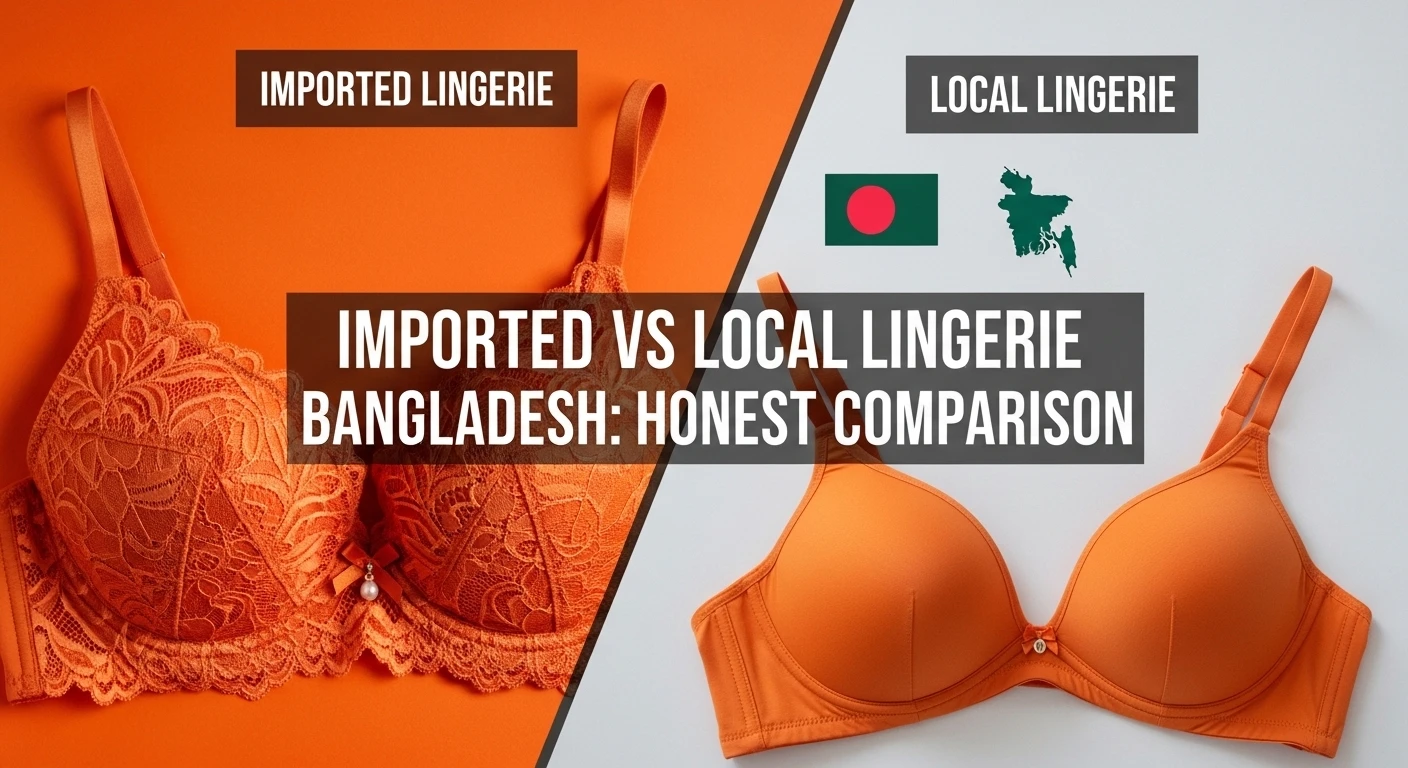
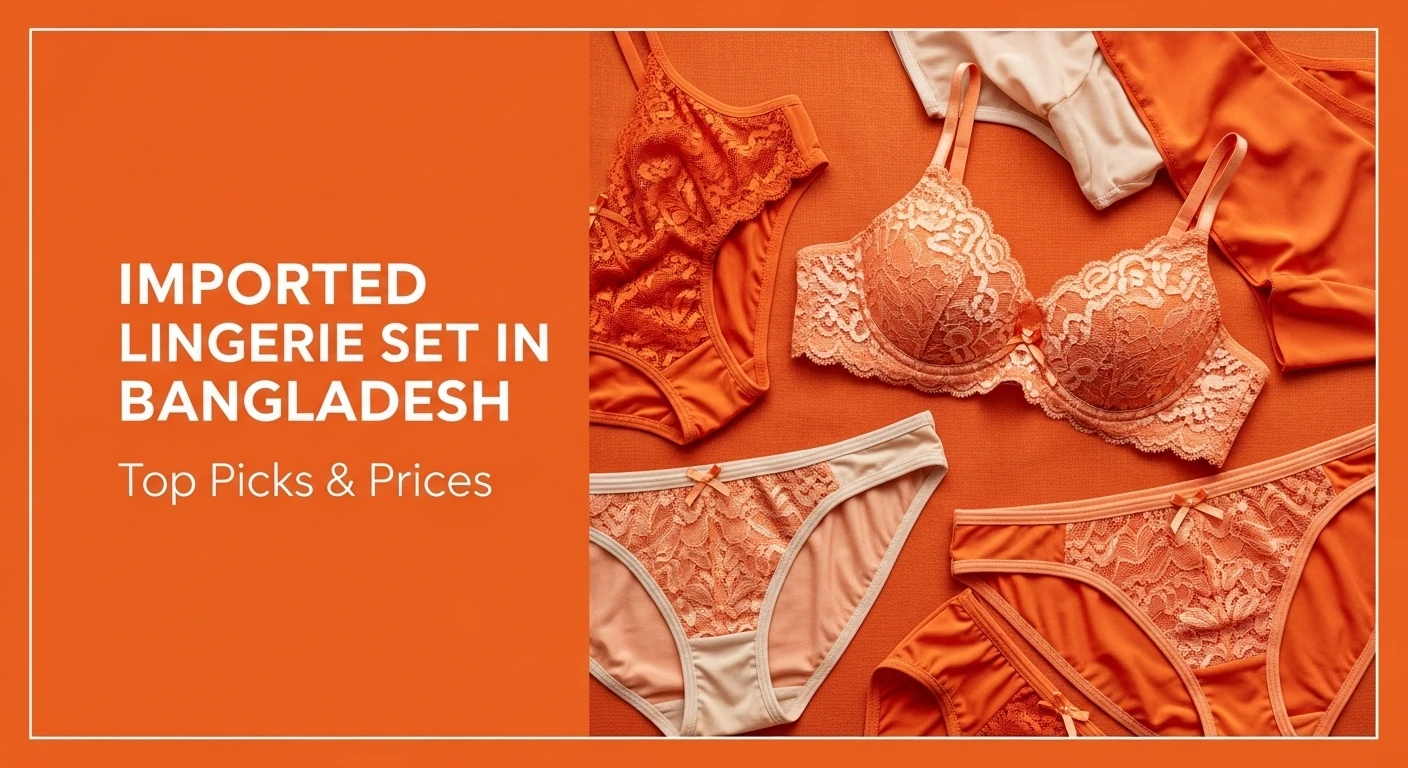
Walk through any lingerie shop in Dhaka's New Market, Bashundhara City, or the smaller neighbourhood stores across Bangladesh, and you will encounter both: locally manufactured bras and underwear made in Bangladesh, and imported pieces arriving from China, India, Turkey, and further afield. Online, the distinction is even more pronounced — some sellers specifically market their products as "imported lingerie" as a quality signal, while others emphasise local manufacturing as a point of pride or as a cost advantage.
But what does imported actually mean for a piece of lingerie in Bangladesh? Does it automatically mean better quality? Is local manufacturing inherently inferior? Are there specific categories where one consistently outperforms the other? And how do you tell the difference when you are shopping online and cannot touch the product?
These are honest questions that deserve honest answers. This guide provides them — without the marketing spin that typically accompanies this debate from either direction.
You can browse lingerie options across different origin and quality tiers at AliPeak, including a curated lingerie sets collection with delivery across Bangladesh.
First, What Does "Imported" Actually Mean in the Bangladeshi Lingerie Market?
The word "imported" is used loosely in Bangladesh's lingerie market, and understanding what it actually covers is important before assigning it any quality value.
Chinese imports make up the largest share of imported lingerie in Bangladesh. China manufactures lingerie across an extraordinary quality range — from ultra-cheap synthetic pieces assembled at minimal cost to genuinely well-engineered bras and sets made to international brand specifications. "Imported from China" therefore means almost nothing by itself as a quality indicator. A ৳150 bra and a ৳2,500 bra may both be imported from China. They are not comparable products.
Indian imports are common across the border, particularly in cotton and everyday lingerie categories. Indian manufacturing in the textile sector is substantial and covers a wide quality range as well. Indian-made cotton nighties and everyday sets are often well-made and appropriately sized for South Asian body types, which gives them a practical advantage over some East Asian sizing conventions.
Turkish imports appear at higher price points and are generally associated with better fabric quality, particularly for lace. Turkish lace manufacturing has a strong global reputation and Turkish-made bras and sets using quality lace are genuine premium products in the Bangladesh market.
Other international brands — primarily European and American — appear at the highest price tier and are genuine premium imports. These are available through select boutiques and online platforms and represent a small fraction of the overall market.
"Imported" as a marketing term without origin: Many sellers in Bangladesh use "imported" without specifying the country of origin. This is often a marketing tactic rather than a genuine quality signal — the product may be a Chinese import of no particular distinction, reframed as "imported" to justify a higher price than a locally made equivalent. When a seller does not specify the origin country, treat the "imported" label with appropriate scepticism.
Bangladesh's Own Lingerie Manufacturing: An Underappreciated Story
Bangladesh is one of the world's largest garment manufacturing countries — the second largest exporter of ready-made garments globally after China. This is not secret knowledge. What is less commonly appreciated is how this manufacturing capacity relates to the domestic lingerie market.
Bangladesh's garment factories produce massive quantities of lingerie and underwear for international export — for European and American brands whose labels end up in stores across the world. Much of this production is genuinely high quality, made to international buyer specifications, using good fabric, precise stitching, and quality control processes.
However, there is a significant disconnect between Bangladesh's export garment quality and the quality of domestically sold Bangladeshi-made lingerie. The best manufacturing capacity in Bangladesh is allocated to export orders with strict international buyer specifications. The domestic lingerie market, which historically has been less quality-conscious and more price-sensitive, has been served by a different tier of local manufacturing — often smaller operations with less precise quality control, lower-grade materials, and less rigorous sizing standards.
This means that "locally made" in Bangladesh covers almost as wide a quality range as "imported from China." There are locally made bras and underwear of genuinely good quality at accessible price points. There are also locally made pieces of poor quality that are only marginally functional.
The practical conclusion: both "imported" and "local" are insufficient quality indicators on their own. The actual quality of any piece of lingerie in Bangladesh depends on the specific manufacturer, the specific materials used, and the specific quality control applied — not on whether it crossed a border.
Where Local Manufacturing Has a Genuine Advantage
Despite the nuances above, there are specific areas where locally made lingerie in Bangladesh has consistent and genuine advantages.
Cotton fabric knowledge and availability: Bangladesh's textile industry has deep expertise in cotton. Locally sourced and locally processed cotton fabrics for everyday underwear and nightwear are often well-made and appropriate for the local climate. A locally made cotton brief or cotton nightgown using quality domestic cotton fabric can genuinely outperform a cheaper imported synthetic alternative.
Sizing for South Asian body types: This is perhaps the most important practical advantage of well-made local lingerie. International sizing — particularly from East Asian sources — is calibrated for body proportions that often differ from the typical Bangladeshi woman's figure. Shoulder width, torso length, cup shape, and hip-to-waist ratio all vary between populations, and lingerie sized for a Chinese or East Asian figure may fit a Bangladeshi woman differently than the label suggests. Locally made lingerie that has been designed with Bangladeshi body proportions in mind fits more reliably for the average Bangladeshi buyer.
Price at quality tier: For everyday cotton basics — briefs, simple nighties, basic bras — locally made pieces at the mid-range price point often represent better value than imported equivalents at the same price. You are not paying a premium for import logistics, and the fabric and construction quality at the ৳400 to ৳800 tier from a quality local manufacturer is frequently as good as or better than imported pieces at the same price.
Turnaround and availability: Locally manufactured pieces have shorter supply chains, meaning they are more reliably in stock, replenished more quickly, and less subject to import-related availability gaps.
Supporting domestic industry: For buyers who care about this dimension, choosing locally made lingerie supports Bangladesh's own manufacturing ecosystem and the workers within it.
Where Imported Lingerie Has a Genuine Advantage
Equally, there are specific categories and quality tiers where imported lingerie consistently outperforms what is available locally.
Lace quality: The finest lace used in premium lingerie — Chantilly lace, Valencienne lace, quality stretch lace with detailed floral or geometric patterns — is manufactured primarily in Europe (France, Belgium, Germany) and, at the mid-range, in Turkey and parts of China with established lace manufacturing traditions. Bangladesh does not have a strong domestic tradition of fine lace production. When quality lace is a priority — for bridal lingerie, occasion sets, or premium gifts — imported lace sets from established sources have a quality ceiling that local alternatives cannot match at equivalent price points.
Bra engineering at the premium tier: The most sophisticated bra construction — precisely moulded cups with anatomically considered shapes, memory foam padding, advanced underwire positioning, gel grip strips on strapless bras — requires manufacturing investment and engineering knowledge that is currently concentrated in international brands and their manufacturing partners. At the ৳2,500 and above tier, imported bras from established brands offer construction quality that the domestic Bangladeshi lingerie market does not yet replicate.
Specialty categories: Some lingerie categories are simply not well-represented in local manufacturing. Nursing bras with quality one-handed clip mechanisms, high-impact sports bras with the engineering needed for running and aerobics, convertible strapless bras with reliable grip strips — these categories require specialist manufacturing investment that is more developed internationally than domestically in Bangladesh.
Satin quality at mid-range and above: Quality satin — smooth, cool, and genuinely silky-feeling — at the mid-range price point is more consistently available from established import sources (particularly Turkish and Indian manufacturers) than from domestic producers, where satin quality at mid-range pricing can be inconsistent.
The Quality Overlap Zone: Where Origin Stops Mattering
It is worth being explicit that there is a very large quality overlap zone where the origin of a piece of lingerie matters far less than its specific materials, construction, and price tier.
A locally made cotton brief at ৳350 using quality domestic cotton single-jersey with a proper cotton gusset lining will perform as well as or better than an imported cotton brief at the same price from a Chinese supplier using equivalent fabric. The origin is irrelevant — the fabric and construction are what matter.
Similarly, a mid-range imported lace set at ৳900 from an undistinguished Chinese supplier may be no better — and possibly worse — than a locally made mid-range set at ৳800 from a quality Bangladesh manufacturer. "Imported" at this price point is not a guarantee of quality; it is a marketing claim that needs to be evaluated on its own merits.
This overlap zone covers the majority of everyday lingerie purchases at the ৳300 to ৳1,500 tier. The most useful question in this range is not where the product comes from but what it is made of, how it is constructed, and whether the price reflects genuine quality or marketing inflation.
How to Evaluate Any Piece of Lingerie Regardless of Origin
Since origin is an unreliable quality proxy, here are the evaluation criteria that actually matter.
Fabric composition: Always look for the specific fabric content — cotton, modal, polyester, nylon, elastane percentage. "Soft premium fabric" and "high-quality material" are marketing language, not fabric descriptions. A product that does not disclose its fabric composition is a product you cannot evaluate properly.
Gusset lining: For any underwear, confirm that the gusset (inner crotch panel) is cotton or cotton-lined. This applies equally to local and imported underwear. A ৳2,000 imported lace brief with a synthetic gusset is a worse health choice than a ৳300 local cotton brief with a proper cotton lining.
Construction details: Look for information about seam construction (flat seams are more comfortable), underwire casing (should be smooth and well-enclosed), elastic quality (wide elastic is gentler than thin), and hook-and-eye gauge (three positions are more durable than one).
Sizing system: Cup-sized bras (34B, 36C) are more reliably fitted than S/M/L labels. This principle applies whether the product is local or imported.
Seller reputation and reviews: On any platform, a seller with consistent positive reviews specifically mentioning fabric quality, accurate sizing, and delivery reliability is a more reliable source than a seller with few reviews or reviews that do not comment on these specifics.
Price realism: Apply the value calculation discussed throughout this series. A ৳200 set is a ৳200 quality set regardless of whether it is imported or local. A ৳1,000 set should deliver meaningfully better quality than a ৳300 set regardless of origin.
Category-by-Category Recommendation
Everyday cotton briefs and hipsters: Local manufacturing advantage. A quality locally made cotton brief using good domestic cotton fabric, properly sized, with a cotton gusset is the right everyday choice. Price-to-quality at the mid-range is strong for local products in this category.
Everyday bras (T-shirt bras, wire-free bras): Roughly equal at mid-range, with imported having an edge at premium. At the ৳500 to ৳1,200 tier, quality local and quality imported products perform similarly for everyday use. Above ৳2,000, imported bras with more sophisticated engineering offer advantages that locally made alternatives currently do not replicate.
Lace occasion and bridal sets: Imported advantage, particularly at mid-range and above. Quality stretch lace with smooth lining is more consistently available from established import sources — particularly Indian, Turkish, and quality Chinese manufacturers — than from local producers. For bridal and honeymoon sets where lace quality matters, imported from a reliable source at the mid-range is the better choice.
Cotton nightwear: Local manufacturing advantage. Quality cotton nighties and pyjama sets are a strength of Bangladesh's domestic textile manufacturing. Well-made local cotton nightwear using quality domestic fabric performs excellently and offers very good value.
Satin nightwear: Imported slight advantage at mid-range. Quality satin — smooth, cool, genuinely silky — is more consistently available from import sources at mid-range prices. Budget satin from any source is poor quality.
Nursing bras: Imported advantage for functionality. The specialised clip mechanisms and engineering of quality nursing bras is more developed in import sources than in domestic manufacturing currently. This is a category where imported from a quality source is the more reliable choice.
Sports bras: Imported advantage for high-impact activity. Performance fabric sports bras with adequate high-impact support require manufacturing investment that is more developed internationally. For yoga and low-impact activity, quality local alternatives are adequate.
Premium occasion sets (bridal, anniversary, honeymoon): Imported advantage at the premium tier. The finest fabrics and most sophisticated construction for premium occasion lingerie come from international sources. For buyers investing in truly premium pieces, imported from an established source is the right choice.
The Honest Summary
The imported versus local debate in Bangladeshi lingerie is genuinely more nuanced than either the "imported is always better" or "support local manufacturing" positions suggest.
For everyday cotton underwear and nightwear — the categories you wear most frequently and that most directly affect daily comfort and health — well-made local products using quality domestic cotton fabrics are an excellent choice that often represents better value than equivalent imported options.
For occasion lingerie, lace sets, premium bras, nursing bras, and high-performance sports bras — the categories where fabric sophistication, engineering quality, and specialist manufacturing matter most — imported from established sources at the appropriate price tier delivers quality that local manufacturing does not yet consistently match.
For everything in between — the large middle ground of everyday bras, mid-range sets, and general lingerie purchases — origin matters less than the specific product's fabric composition, construction quality, and price realism. Evaluate those factors directly rather than using origin as a shortcut.
The best lingerie wardrobe for a Bangladeshi woman is not exclusively imported and not exclusively local. It is a practical combination: local cotton basics for everyday use, selectively imported pieces for occasions where quality specialisation matters, and a consistent focus on fabric and construction quality as the primary evaluation criteria regardless of where the label says the product was made.
Browse a curated selection of lingerie and nightwear at AliPeak — the lingerie sets collection covers both locally sourced and quality import options across everyday and occasion categories, with clear product descriptions and nationwide delivery across Bangladesh.
 english




 Automotive
 Gifts & Occasions
 Electronics & Computers
 Fashion & Apparel
 Beauty & Personal Care
 Home & Lifestyle
 Sports & Fitness
 Books, Movies & Music
 Baby & Kids