Written for readers who love sarees and care about informed choices.
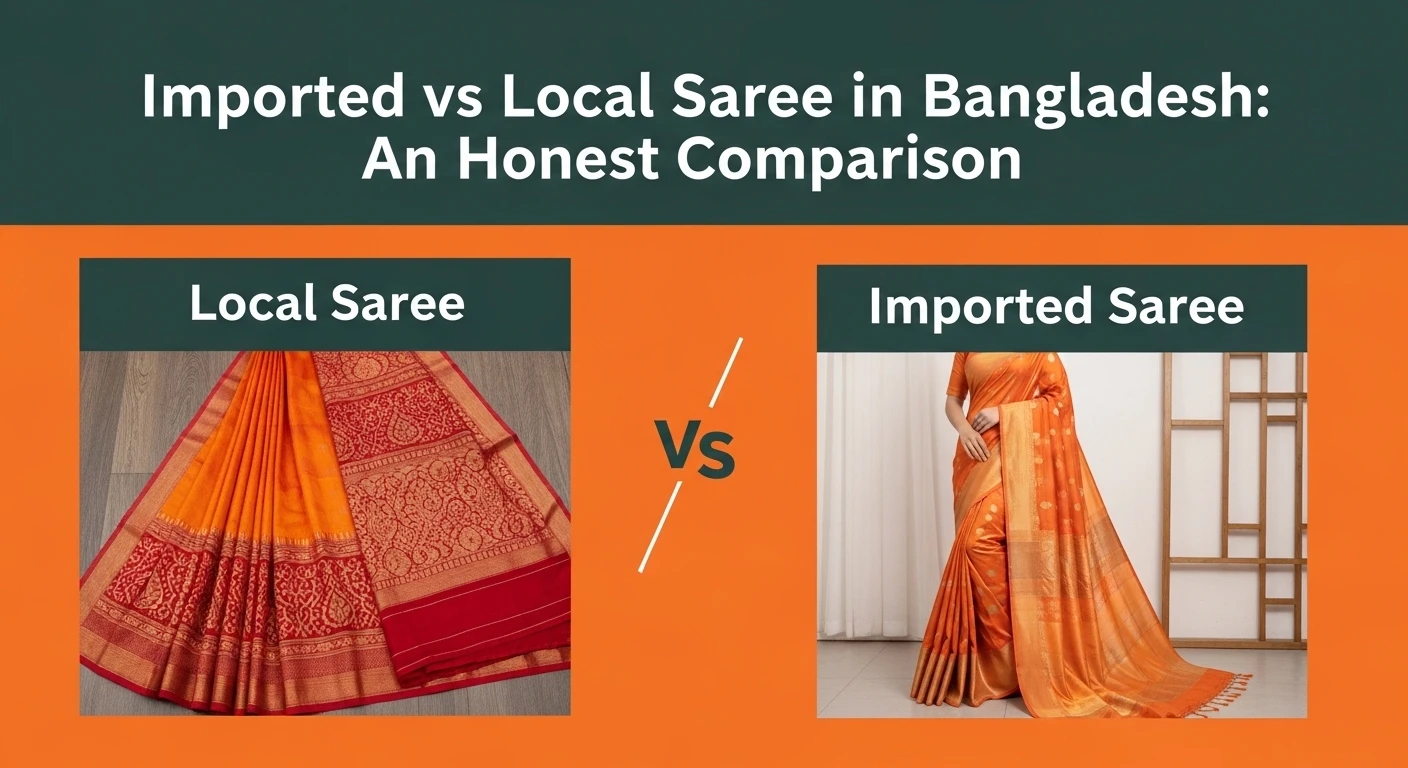
The saree is more than just a garment in Bangladesh — it is a living symbol of cultural identity, femininity, and artistic heritage. From the humble village bazaar to the grand boutiques of Dhaka's Gulshan district, sarees occupy a central place in Bangladeshi life. Yet in recent years, a heated debate has emerged in drawing rooms, fashion circles, and online communities alike: should you buy a locally made saree or an imported one?
The answer, as with most things in fashion, is not simple. Both imported and locally made sarees have devoted followings and very real advantages. This article takes an honest, in-depth look at both sides — covering quality, price, craftsmanship, cultural value, availability, and more — so you can make an informed choice the next time you stand in front of a saree shop.
1. The Landscape: What's Available in Bangladesh?
Bangladesh has one of the richest textile traditions in the world. Centuries-old weaving communities in Tangail, Rajshahi, Mirpur, Narsingdi, and Pabna have produced iconic sarees recognized internationally. At the same time, the country's open market and cross-border trade have made imported sarees — particularly from India — widely accessible.
Key local varieties include:
- Jamdani (UNESCO-recognized intangible cultural heritage)
- Rajshahi Silk (pure mulberry silk from Rajshahi district)
- Tangail Cotton Saree (lightweight, everyday wear)
- Muslin (historically renowned, now being revived)
- Benarasi (locally adapted version of the Indian classic)
- Khadi (handspun, eco-friendly fabric)
Popular imported varieties include:
- Indian Banarasi Silk (from Varanasi, Uttar Pradesh)
- Kanjivaram Silk (from Tamil Nadu)
- Georgette and Chiffon Sarees (mass-produced in India)
- Organza and Net Sarees
- Chinese synthetic sarees (polyester, satin blends)
2. Quality and Craftsmanship
Local Sarees
When it comes to artisanal quality, Bangladeshi sarees are world-class. A genuine Jamdani saree can take a master weaver anywhere from two weeks to three months to complete. The intricate floral and geometric motifs are woven directly into the fabric using the supplementary weft technique — no printing, no shortcuts. The result is a textile of extraordinary beauty and durability.
Rajshahi Silk is distinguished by its natural luster, fine texture, and breathability. Tangail cotton sarees, though more everyday in character, are valued for their durability, comfort in the tropical Bangladeshi climate, and charming simplicity of pattern.
However, quality varies enormously in the local market. Machine-made imitations of Jamdani and Rajshahi Silk have flooded the market, and an untrained eye may easily pay a premium for an inferior substitute. Buyer awareness and purchasing from reputable sources is essential.
Imported Sarees
High-end imported sarees — such as genuine Kanjivaram or Banarasi from India — are also masterpieces of craftsmanship, known for their heavy zari (gold and silver thread) work, rich silk weaves, and opulent appearance. For wedding occasions and festive events, many Bangladeshi families traditionally opt for these prestigious fabrics.
On the other end, mass-market imported sarees from India and China — georgette, chiffon, and polyester blends — are often machine-made with standardized prints. They are consistent in finish but carry little artisanal value. While they look attractive and come in trendy designs, they generally do not hold up as well over time.
Verdict: For handcrafted artisanal quality, premium local sarees lead. For heavy ceremonial silk work, certain imported varieties remain highly competitive.
3. Price: What Does Your Money Buy?
Price is one of the most significant factors for most buyers, and this is where the comparison becomes nuanced.
Local Saree Price Ranges (approximate):
- Tangail cotton: BDT 500–3,000
- Basic Jamdani: BDT 2,000–8,000
- Premium handloom Jamdani: BDT 10,000–50,000+
- Rajshahi Silk: BDT 3,000–20,000
- Muslin revival pieces: BDT 15,000–1,00,000+
Imported Saree Price Ranges (approximate):
- Indian georgette/chiffon: BDT 1,000–5,000
- Indian Banarasi Silk: BDT 5,000–40,000
- Kanjivaram Silk: BDT 15,000–80,000+
- Chinese synthetic sarees: BDT 400–2,500
At the budget end, local sarees offer better value — a quality Tangail saree at BDT 1,500 will outlast a Chinese synthetic of the same price. In the luxury segment, imported Indian silks sometimes offer more intricate zari work for a comparable price to Bangladeshi equivalents. It is also worth noting that imported sarees carry significant markups due to import duties and retail margins — a Banarasi that sells for INR 8,000 in India may cost BDT 18,000–22,000 in a Dhaka shop.
Verdict: Local sarees generally provide better value across most price points, particularly in the low-to-mid range.
4. Design and Variety
One of the most common criticisms of local sarees — particularly among younger buyers — is that they can feel traditional or conservative in design. Imported sarees, especially from India, have historically offered more variety in modern cuts, trendy prints, and fusion styles. Indian sarees benefit from a massive upstream fashion industry where Bollywood trends and designer collections continuously refresh available styles.
That said, local designers and boutiques have made significant strides. Brands such as Aarong, Rang Bangladesh, and Deshal have brought local textiles into the modern fashion conversation, creating sarees that feel both rooted in heritage and relevant to contemporary tastes. Jamdani sarees, in particular, have seen a renaissance in modern color palettes and minimalist designs.
Verdict: Imported sarees currently offer broader variety and trend-driven options. However, the gap is closing as local designers invest in modernizing traditional textiles.
5. Cultural Identity and Emotional Value
A Jamdani saree is not merely a piece of cloth. It is a UNESCO-recognized cultural treasure. It carries in its threads the stories of Dhaka's weavers, the legacy of Mughal patronage, the resilience of a craft that survived colonialism, and the identity of a nation. Wearing one on Pohela Boishakh or a family wedding is an act of cultural affirmation — a participation in the preservation of living heritage.
Imported sarees carry their own cultural histories — a Kanjivaram is a point of pride for Tamil Nadu, a Banarasi for Uttar Pradesh. There is nothing wrong with appreciating these beautiful traditions. But in the context of Bangladesh, choosing imported over local has economic and cultural implications that thoughtful buyers consider.
Verdict: For cultural resonance and national identity, local sarees are unmatched. This is a deeply personal dimension that goes beyond utility.
6. Economic Impact: Where Does Your Money Go?
When you buy a local handloom saree, your money flows directly (or nearly so) to Bangladeshi weavers, dyers, traders, and small business owners. The handloom sector supports millions of livelihoods across rural Bangladesh — many weavers in Tangail and Narsingdi live in modest circumstances, and steady demand is a lifeline for their families.
When you buy an imported saree, your money largely leaves the national economy — enriching manufacturers and traders in India or China and paying import duties to the Bangladesh government, but the primary value creation happens elsewhere. This is not a moral judgment, but it is an economic reality that informed consumers factor into their decisions.
Verdict: Buying local has significantly stronger positive economic impact on Bangladeshi communities and heritage industries.
7. Comfort and Wearability
Bangladesh's hot and humid climate strongly favors natural fabrics. On this count, local cotton and silk sarees — particularly Tangail cotton and Jamdani — are exceptionally well-suited to the local environment. They breathe well, feel light on the body, and keep the wearer cooler than synthetic alternatives.
Many imported sarees — especially trendy georgette, chiffon, and net varieties — are partly or wholly synthetic. They may look glamorous but can be uncomfortable in warm weather. High-end imported silks like Kanjivaram are naturally breathable but are heavy, making them less practical for everyday or extended wear.
Verdict: For everyday comfort in the Bangladeshi climate, local natural-fiber sarees outperform most imported alternatives.
8. The Problem of Counterfeits and Authenticity
Both categories suffer from serious counterfeit problems in Bangladesh. Fake Jamdani — machine-printed fabric sold as hand-woven — is rampant, and unscrupulous sellers even use GI (Geographical Indication) tags fraudulently. Similarly, many sarees sold as "Indian Banarasi" or "Kanjivaram" in Bangladeshi markets are cheap imitations produced in power looms.
The solution is the same in both cases: buy from trusted retailers, look for certification where available, and develop a basic knowledge of the difference between machine and hand-woven fabrics. The price can also be a useful signal — a genuine hand-woven Jamdani cannot realistically be sold at the price of a machine-made copy.
Verdict: Neither category has a clean record on authenticity. Due diligence is essential regardless of your choice.
9. Sustainability and Environmental Considerations
Local handloom sarees made using traditional techniques with natural fibers have a significantly lower carbon footprint than machine-produced imported alternatives. The production process is largely manual, does not rely on heavy industrial machinery, and often uses natural dyes. Khadi, in particular, is celebrated as one of the most sustainable fabrics in the world.
Imported synthetic sarees are produced in factories with high energy consumption, often use synthetic dyes, and contribute to microplastic pollution when washed. International transport also adds to their environmental cost.
Verdict: Local handloom sarees are considerably more sustainable and environmentally responsible.
10. Availability and Shopping Experience
Imported sarees, particularly Indian ones, are extraordinarily accessible in Bangladesh. From sprawling saree markets in New Market and Mirpur to e-commerce platforms and local boutiques, imported varieties are everywhere. Seasonal sales tied to Eid, Puja, and wedding seasons bring fresh stocks regularly.
Authentic local sarees — especially premium handloom pieces — require more effort to source. Genuine Jamdani is best purchased from weavers in Rupganj, certified cooperatives, or reputable retailers like Aarong and Banglar Mela. Online platforms like Shajgoj and boutique Facebook pages have improved accessibility in recent years, but the experience remains more curated.
Verdict: Imported sarees win on sheer accessibility and convenience. Authentic local sarees require more intentional purchasing.
Conclusion: The Honest Verdict
There is no single winner in the debate between imported and local sarees in Bangladesh. The right choice depends entirely on what you value most.
If you prioritize cultural heritage, sustainability, artisanal craftsmanship, and economic impact, a quality local saree is the clear and compelling choice. Bangladesh produces some of the most exquisite textiles in the world — the tragedy is that many Bangladeshis do not fully realize it.
If you want the broadest design variety, the convenience of easy availability, or the specific aesthetic of Indian silk sarees for a wedding or ceremony, imported varieties remain a legitimate and attractive option.
But perhaps the most important takeaway is this: whatever you choose, choose consciously. Know where your saree comes from, who made it, and what you are paying for. In doing so, you honor not just the garment, but the centuries of human skill and creativity woven into every thread.
© Article prepared for informational and editorial use.
 english




 Automotive
 Gifts & Occasions
 Electronics & Computers
 Fashion & Apparel
 Beauty & Personal Care
 Home & Lifestyle
 Sports & Fitness
 Books, Movies & Music
 Baby & Kids