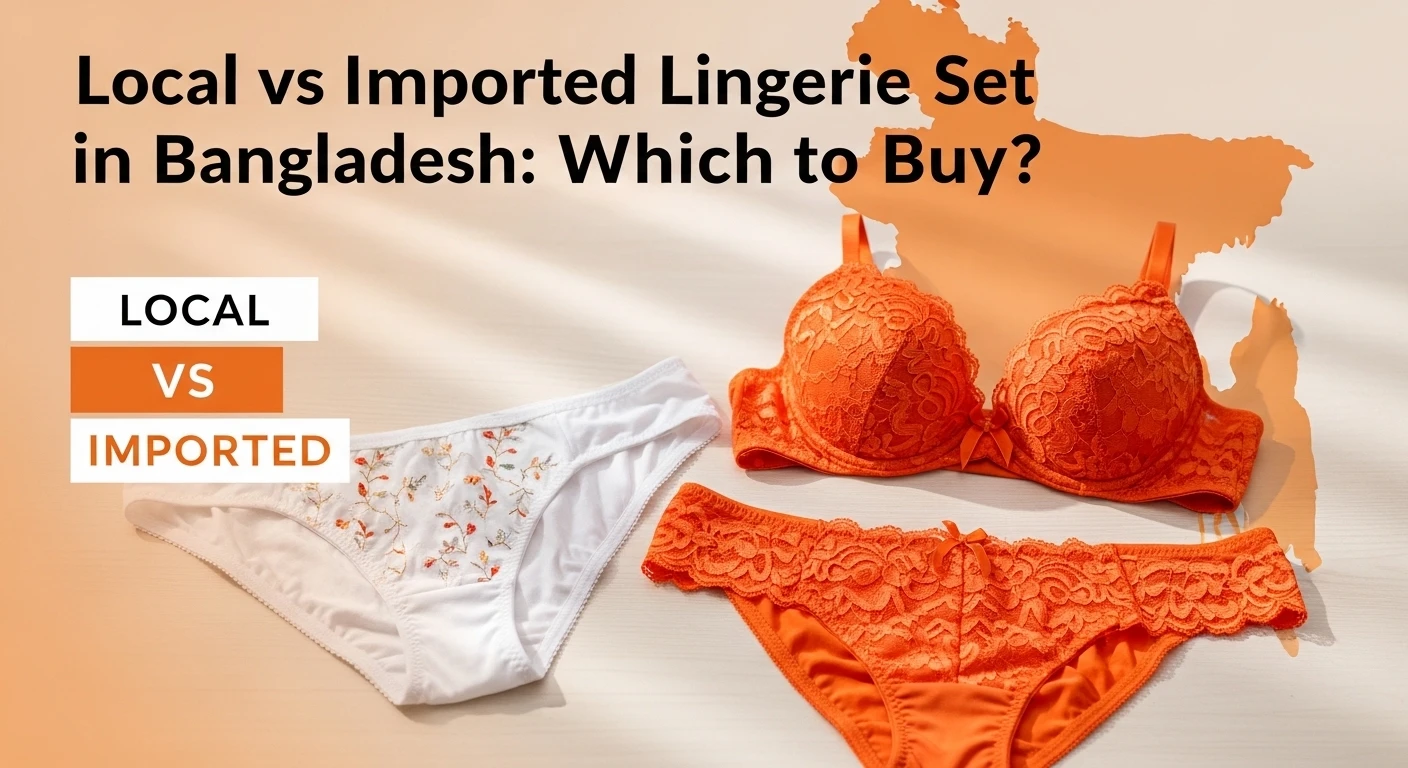
An honest, detailed comparison of locally made and imported lingerie in Bangladesh — covering quality, price, fabric, sizing, and where your money is better spent.
Walk into any lingerie shop in Bangladesh — physical or online — and you face a fundamental choice that most buyers make on instinct rather than information: local or imported?
The instinct usually runs in one direction. Many Bangladeshi women assume that imported lingerie is automatically better — that the "Made in India," "Made in China," or unlabeled-but-clearly-foreign labels signal quality that local production cannot match. Others swing the opposite way, distrusting imports as overpriced foreign goods that do not suit Bangladeshi bodies, tastes, or budgets.
Both instincts are partly right and largely wrong. The reality, as with most things in fashion, is more nuanced — and more useful — than either assumption.
This guide does what neither instinct does: it compares local and imported lingerie in Bangladesh honestly, category by category, on the specific factors that actually determine whether a lingerie purchase is a good one. By the end, you will have a clear framework for deciding which to buy — not based on where the label was sewn, but on what actually matters.
To browse a curated range of both local and imported lingerie options, you can explore the Alipeak lingerie collection — one of Bangladesh's most comprehensive online lingerie destinations covering quality pieces across both categories.
Setting the Terms: What Are We Actually Comparing?
Before comparing, it helps to be precise about what "local" and "imported" mean in the Bangladesh lingerie market.
Local Lingerie
"Local" in the Bangladesh context covers a wide spectrum:
Domestically manufactured branded lingerie — products designed and produced within Bangladesh by established brands or manufacturers. Bangladesh has a thriving garment manufacturing industry, and some of that capacity is directed at the domestic lingerie market.
Local boutique and artisan production — small-scale producers, Instagram boutiques, and independent sellers who design and produce in Bangladesh, often in small batches with more attention to individual quality.
Locally assembled from imported fabric — some products sold as "local" are cut and sewn in Bangladesh from imported fabric (often from China or India). The garment is assembled locally but the materials are foreign.
Understanding which category you are in is important. A garment assembled in Bangladesh from cheap Chinese synthetic fabric is "local" only in the narrowest technical sense.
Imported Lingerie
"Imported" covers an equally wide range:
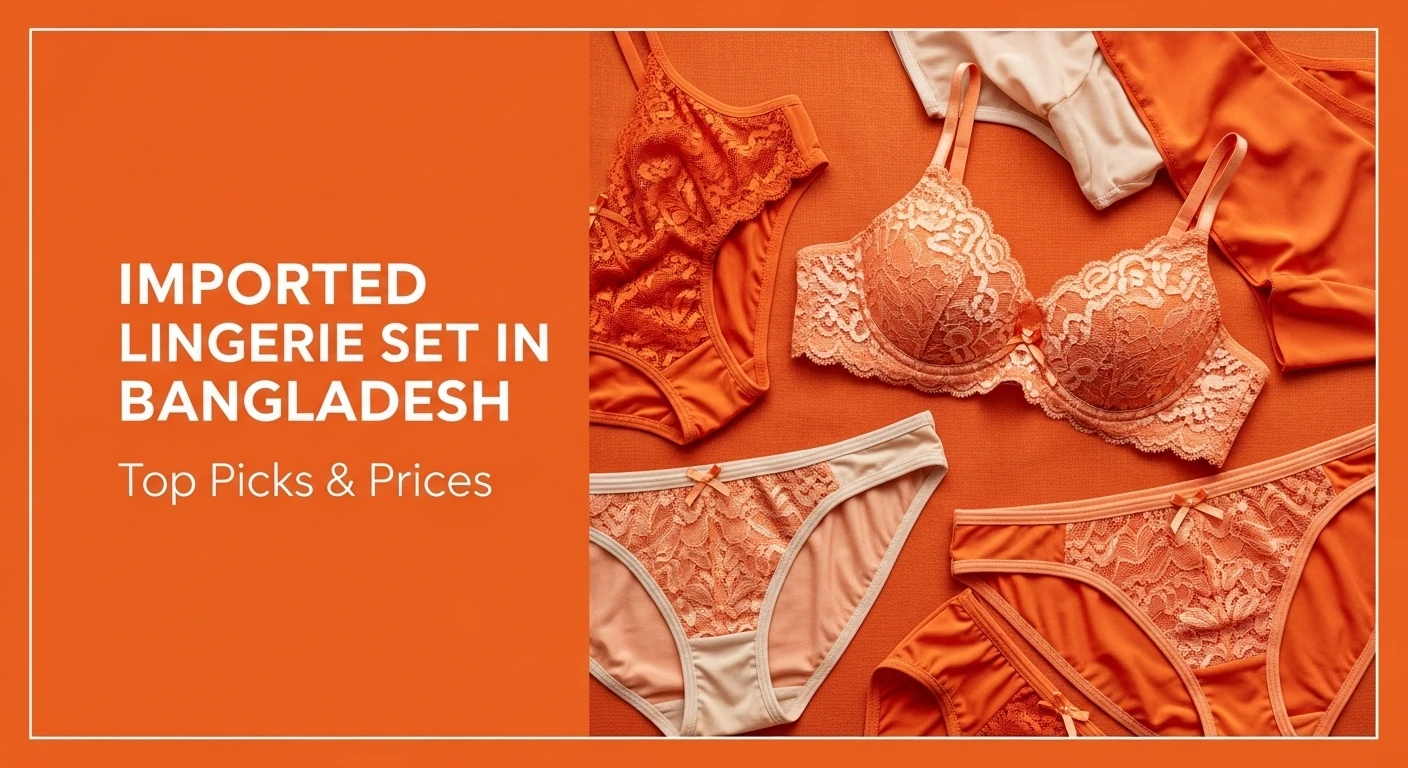
Premium brand imports — genuine branded lingerie from international brands (Triumph, Intimissimi, La Senza) imported through authorized channels. The most expensive category.
Indian e-commerce brands — lingerie from Indian online brands (Shyaway, Clovia, Zivame) that ship to Bangladesh. A significant share of the imported lingerie market.
Chinese bulk imports — unbranded or generic lingerie manufactured in China and imported wholesale. The majority of budget-price "imported" lingerie in Bangladesh falls into this category.
Grey market imports — foreign-brand lingerie brought into Bangladesh informally, without official distribution. Quality and authenticity are variable.
A BDT 15,000 imported Intimissimi set and a BDT 400 unlabeled Chinese import are both "imported" — they have almost nothing else in common.
With these distinctions established, the comparison becomes much more useful.
Round 1: Fabric and Material Quality
Local
Bangladesh's garment manufacturing heritage means genuine competence exists in fabric selection and textile quality at the domestic level. Local boutiques and quality-conscious domestic brands can and do source good cotton, fine linen, and even silk — including Bangladesh's own Rajshahi Silk — for lingerie production.
The best local lingerie in Bangladesh uses fabrics that are genuinely suited to the local climate and body: natural fibers, breathable constructions, cotton gussets as standard practice. A locally made cotton brief set from a quality-conscious producer uses fabric selected for comfort in Bangladesh's warm, humid conditions — which is exactly right.
At the lower end, cheap local lingerie uses the same low-grade synthetic fabrics as cheap imports — the local origin does not guarantee material quality.
The local advantage on fabric: When a local producer uses natural fibers — particularly Bangladeshi cotton — the climate suitability and breathability is often superior to imported synthetic alternatives. For a detailed explanation of exactly how fabric quality determines garment longevity, see our article Why Cheap Punjabi Falls Apart After One Wash — the same fiber quality principles apply directly to lingerie.
Imported
Imported lingerie covers the full quality spectrum. At the premium end — genuine European brands, quality Indian manufacturers — the fabric quality is genuinely excellent. Micro modal from Intimissimi, quality stretch cotton from M&S, engineered performance fabric from premium sports lingerie brands — these are materials that domestic producers rarely match.
At the budget end — Chinese bulk imports, the lowest-tier Indian production — the fabric quality is often poor. Thin, non-breathable synthetics that feel acceptable in the shop and deteriorate rapidly with washing. The "silky" fabric that is entirely polyester. The elastic that loses its stretch within a month.
The critical insight: fabric quality correlates with price and brand integrity, not with country of origin. A cheap import is not better than a quality local piece simply because it is imported. A premium import is often genuinely superior to what local production offers at the same price point.
Verdict on fabric: Premium imported > quality local > cheap local ≈ cheap imported. The origin matters less than the price tier and the specific brand's quality standards.
Round 2: Construction Quality
Local
Construction quality in locally made lingerie varies enormously by producer tier. The very best local producers — quality-conscious boutiques and domestic brands with genuine QC processes — produce lingerie with clean seam finishing, cotton-lined gussets, proper elastic attachment, and careful symmetrical construction.
The worst local producers — unaccountable market stall production — cut every possible construction corner. Raw seam edges. Synthetic gusset lining. Poor stitch density. Hardware that fails within weeks.
Bangladesh's garment manufacturing sector has genuine construction expertise — the country makes clothing for the world's largest brands — but that expertise does not automatically filter into domestic lingerie production. The brands and producers who apply it are excellent. The majority do not.
Imported
The same spectrum applies to imports. Premium imported lingerie from quality brands — whether European, Indian, or other — has construction standards that reflect genuine quality investment: flat seams, cotton gussets, enclosed elastic, quality closures.
Bulk Chinese imports, on the other hand, often have some of the worst construction quality available in the Bangladesh market. The gusset lining is synthetic. The elastic is thin rubber that hardens within a few washes. The stitch density is minimal. The seam finishing is rough against the skin.
The "imported" label on a BDT 400 Chinese-origin brief set is not a quality credential. It is simply a country of origin.
For a buyer's guide to evaluating construction quality in any lingerie piece — local or imported — our Best Push-Up Bra Set in Bangladesh: Top Picks and Best Bodysuit Lingerie in Bangladesh 2026 guides both contain detailed quality checklists that apply universally.
Verdict on construction: Quality brand (imported or local) > bulk production (imported or local). The specific brand and production tier matters far more than the country of origin.
Round 3: Sizing and Fit
This is one area where the local versus imported comparison produces a genuinely clear result — and it may not be the one you expect.
Local
Many domestic lingerie producers in Bangladesh use S/M/L/XL sizing rather than standardized cup and band measurements. This is a significant problem for bras and structured lingerie where proper sizing is essential for both comfort and function.
However, local boutiques — particularly the better Instagram and Facebook-based sellers — have an advantage that no imported brand can replicate: direct communication with the buyer. A local seller can take custom measurements, make adjustments for atypical proportions, and produce garments sized to an individual rather than a standard. For women whose measurements fall outside standard size ranges, this local advantage is genuinely significant.
Local production also has the potential to better suit the specific body proportions more common among Bangladeshi women — though this potential is only realized when local producers actually design with these proportions in mind rather than simply copying imported patterns at a lower price.
Imported
Premium imported brands — Triumph, M&S, quality Indian brands — use standardized cup and band sizing that is internationally consistent and verifiable. This is a significant advantage. If you know you are a 34B in Triumph, you know what you are getting. The sizing is predictable and reliable.
The limitation is that international size ranges are designed for international body averages. Some imported brands — particularly those designed primarily for Western or upper-South-Asian markets — have cup and band proportions, strap placement, and torso measurements that do not always suit the full range of Bangladeshi body types optimally.
Budget Chinese imports, while technically "imported," often use sizing that is inconsistent, runs small, and has little relationship to international standards.
If you are uncertain of your correct bra size or have been experiencing fit problems with both local and imported options, our detailed guide Why Your Bra Doesn't Fit (And How to Fix It) explains how to measure yourself correctly and evaluate fit on any piece — regardless of origin.
Verdict on sizing: Premium imported brands win on consistency and standardization. Local custom production wins for atypical proportions. Budget options in both categories lose on sizing reliability.
Round 4: Price and Value for Money
Local
Locally produced lingerie has a potential cost advantage from reduced import duties, lower logistics costs, and domestic labor pricing. At the everyday level, a quality locally made cotton brief set can offer very good value — good fabric, proper construction, fair price.
The challenge is that the local market has trained many buyers to expect very low prices — and producers have responded by cutting quality to meet those price expectations. The genuinely well-made local lingerie set is often priced higher than buyers expect, because real quality has a minimum cost regardless of origin.
At the top of the local market, quality boutique lingerie can be expensive relative to what equivalent imported options cost — the small-scale local production that justifies the price is excellent, but it is priced accordingly.
Imported
Premium imported lingerie carries a significant price premium in Bangladesh — import duties, logistics costs, and retailer margins can make imported branded lingerie cost substantially more in Bangladesh than the same piece costs in its country of origin.
Budget imported lingerie — Chinese bulk imports and the lowest tier of Indian production — appears cheap but often delivers very poor value. As we explain in detail in Why Cheap Punjabi Falls Apart After One Wash, cheap garments cost more in the long run when quality and longevity are factored in. A BDT 400 Chinese-import brief that lasts three washes costs more annually than a BDT 1,200 quality piece that lasts two years.
The best value in imported lingerie comes from the mid-range Indian e-commerce brands (Shyaway, Clovia) and from established brands like M&S and Triumph — where the quality genuinely justifies a moderate price premium over the cheapest local alternatives.
Verdict on value: Quality local production offers the best value at the everyday end. Premium imported brands offer genuine quality at a price premium. Budget options in both categories offer poor real-world value regardless of their price tag.
Round 5: Climate Suitability
This is an underappreciated dimension of the local versus imported debate that has real daily impact on comfort.
Local
At its best, locally produced lingerie is designed for Bangladesh's specific climate conditions — hot, humid summers, warm monsoon seasons, and a mild but genuine winter. Natural cotton fabrics, breathable constructions, and moisture-wicking properties are all more likely to be prioritized by a local producer designing for local conditions.
A locally made cotton brief set designed for tropical wear is genuinely more comfortable in Bangladesh's summer than an imported synthetic set designed for a temperate European climate.
Imported
Premium European and quality Indian brands produce excellent lingerie — but some of it is designed for climates significantly different from Bangladesh's. Thick padding, heavy synthetic fabric, and non-breathable construction that is perfectly sensible for a European winter is uncomfortable in a Bangladeshi summer.
Chinese bulk imports often use thin synthetic fabrics that feel cool initially but trap heat and moisture against the skin — the opposite of what Bangladesh's climate requires.
The important exception: Indian lingerie brands designing for the Indian subcontinent — where climate conditions are very similar to Bangladesh — are often better climate-suited than European imports. Brands like Triumph's Asian-market range also take tropical climate requirements into account.
Verdict on climate suitability: Quality local natural-fiber production has the edge for warm-weather daily wear. Indian subcontinent brands are competitive. European brands and Chinese synthetics can be poorly suited to Bangladesh's climate.
Round 6: Variety and Style
Local
The local Bangladesh lingerie market has historically offered limited variety in terms of design diversity, fashion-forward styles, and the range of specialist categories (sports bras, nursing bras, shapewear, etc.). Domestic retail coverage of these categories has been thin.
This is changing. Instagram and Facebook boutiques have brought much greater variety to the local market, and some domestic producers are genuinely investing in design. But in 2026, the honest assessment is that local production still offers less design diversity than the best imported options.
Imported
The imported lingerie market in Bangladesh — particularly through online channels — offers access to an enormous variety of styles, specialist categories, and design approaches that domestic production cannot match. Push-up variations, bodysuit styles, specialist shapewear, bridal collections, sports lingerie — the breadth available through imported channels substantially exceeds local production.
For women who have specific style needs or are looking for particular categories of lingerie — a plunge push-up for a specific garment, a silk chemise in a particular color, a properly engineered sports bra — the imported market is where those specific needs are most likely to be met.
Our guides on Best Silk Lingerie Set in Bangladesh, Best Push-Up Bra Set in Bangladesh, and Best Bodysuit Lingerie in Bangladesh 2026 all draw substantially from imported options because the local market does not yet offer comparable variety in these specialist categories.
Verdict on variety: Imported wins clearly on design diversity and specialist category coverage.
Round 7: Bridal and Occasion Lingerie
This is a category that deserves its own section given its importance in Bangladesh.
Local
Some of the most beautiful bridal lingerie in Bangladesh comes from local boutiques — particularly Instagram and Facebook-based sellers who specialize in bridal collections and offer personalized service, custom sizing, and pieces designed specifically for the Bangladeshi bridal context.
The best local bridal lingerie sellers understand the specific needs of a Bangladeshi bride — the pieces required for different wedding events, the color preferences, the cultural context — in a way that no imported brand can match.
For a full picture of what a Bangladeshi bride needs in her lingerie trousseau, our Bridal Trousseau Checklist for Bangladesh is essential reading before shopping for any bridal lingerie, whether local or imported.
Imported
Premium imported bridal lingerie — from established brands available through platforms like Alipeak — offers construction quality and fabric luxury that local boutiques often cannot match for the most significant pieces: the wedding night set, the silk robe, the embellished bralette.
The best bridal trousseau approach in Bangladesh in 2026 is likely a combination: local boutique pieces for the personalized, culturally resonant items, and quality imported pieces from established platforms for the premium fabric and construction categories.
Verdict on bridal: Best outcome comes from combining quality local boutiques for personalization with established platform imports for premium construction and fabric.
The Honest Summary: A Decision Framework
Rather than declaring a single winner — which would be oversimplifying a genuinely nuanced comparison — this decision framework gives you the right answer for your specific situation.
Buy Local When:
- You need custom sizing outside standard size ranges
- You want natural fiber, climate-appropriate everyday basics at fair prices
- You are buying from a verified quality-conscious boutique with good reviews
- You want a personalized bridal piece with cultural specificity
- You are confident in the seller's quality claims and have verified them
- You want to support Bangladeshi small businesses and artisans
Buy Imported When:
- You need a standardized, verifiable cup-and-band size in a reliable brand
- You want specialist categories (silk sets, engineered push-up, shapewear, sports bras) that local production does not cover well
- You are buying from an established brand or curated platform with accountability
- You want premium fabric quality — genuine mulberry silk, micro modal, quality cotton — that local production rarely offers
- You need extended size ranges beyond what local producers typically offer
Buy from a Curated Platform (Local or Imported) When:
- You want a reliable quality standard without extensive individual seller research
- You are building a complete lingerie wardrobe or bridal trousseau and need variety in one place
- You want buyer accountability and consistent quality regardless of individual product origin
The Alipeak lingerie collection covers all of these scenarios — curating quality pieces across both local and imported categories, with the fabric transparency and construction standards to make the right choice accessible regardless of origin preference.
What to Always Check Regardless of Origin
Whether you are buying local or imported lingerie, the same quality checklist applies. The questions that matter are not "where was this made?" but:
- What is the fabric fiber content? Cotton, silk, or synthetic? Natural fibers for everyday; verify silk is real silk.
- Is the gusset cotton-lined? Non-negotiable for any brief, bodysuit, or gusset-containing piece.
- What is the elastic quality? Soft, recovery-maintaining elastic or cheap rubber that will harden within weeks?
- Are the seams flat and finished? No raw edges, no rough stitching against the skin.
- Does the sizing follow cup-and-band or S/M/L? Cup-and-band is the only reliable system for bras.
- Does the price reflect the claimed quality? Real quality has a minimum price floor regardless of origin.
These questions apply equally to a local Instagram boutique set and an imported brand piece. Apply them every time and the local versus imported question becomes secondary to the quality question.
Final Thought
The local versus imported debate in Bangladesh lingerie is, ultimately, a proxy debate about quality, value, and accountability. The labels — local, imported, Made in Bangladesh, Made in India, Made in China — tell you something but not everything. They do not tell you whether the elastic will last, whether the gusset is cotton, whether the silk is genuine, or whether the size will fit.
The questions that actually determine whether a lingerie purchase is a good one are about fabric, construction, fit, and price — not origin. The best lingerie purchase you can make in Bangladesh in 2026 is one where you know the answers to those questions before you buy, regardless of which country produced the garment.
Start with the quality framework. Apply it consistently. And shop wherever — local boutique, established import brand, or curated platform — that framework tells you is right for the specific piece you need.
Browse the full curated range at Alipeak for options that meet quality standards across both local and imported categories, all in one place.
For more guides on choosing, fitting, and building your lingerie wardrobe in Bangladesh, explore the full article collection at alipeak.com.
Pricing and availability are based on Bangladesh market conditions in 2026 and are subject to change.
 english




 Automotive
 Gifts & Occasions
 Electronics & Computers
 Fashion & Apparel
 Beauty & Personal Care
 Home & Lifestyle
 Sports & Fitness
 Books, Movies & Music
 Baby & Kids