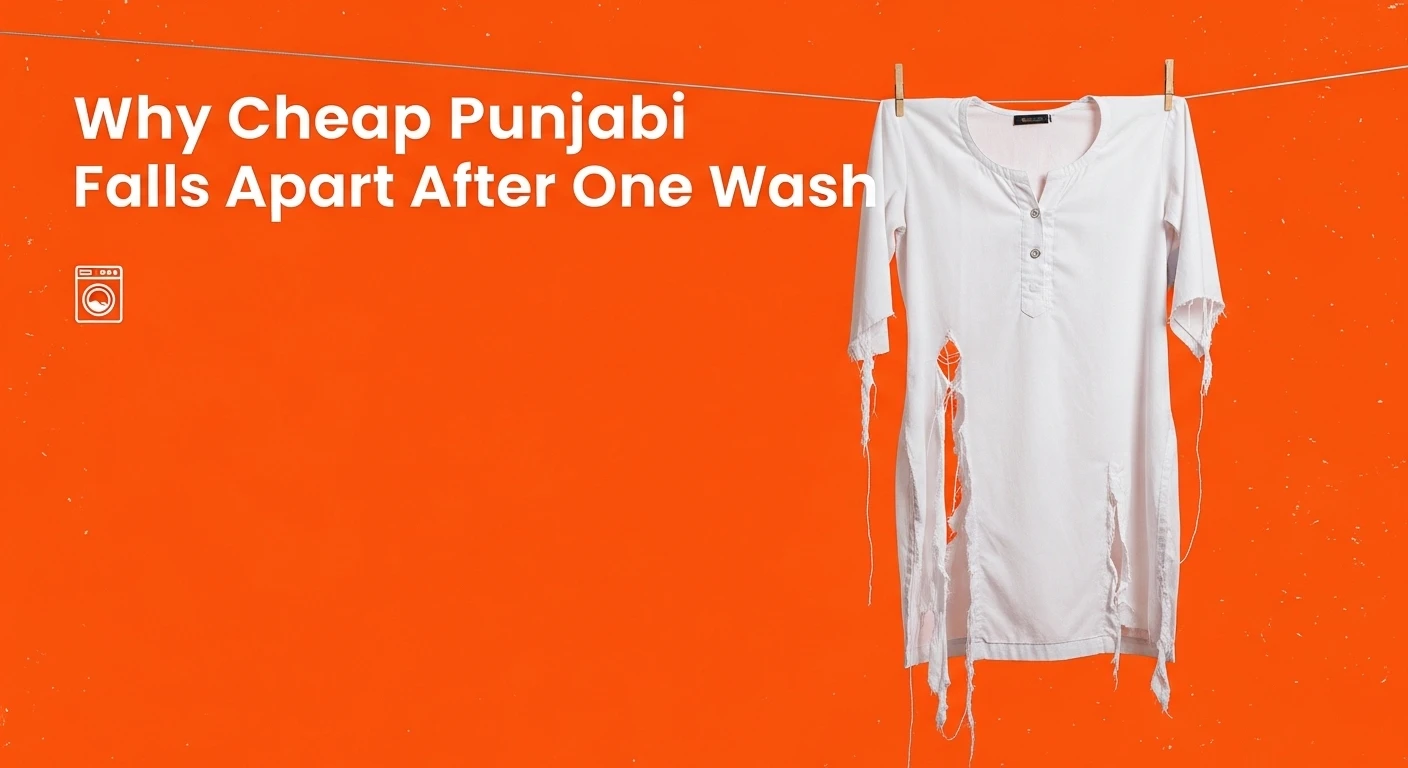
The honest, technical truth about what you are actually buying when you pay BDT 400 for a Panjabi — and why it cannot last.
It happens to almost every man who has ever bought a budget Panjabi from a market stall, a roadside shop, or a fast-fashion retailer in Bangladesh. You bring it home. It looks presentable enough. The color seems fine, the stitching holds, the fabric feels smooth in the shop. You wash it once — and something is immediately, obviously wrong.
The color has bled or faded dramatically. The fabric has shrunk and now fits a man considerably shorter than you. The stitching along the side seam has unraveled. The collar has puckered and will not lie flat again no matter what you do with the iron. The fabric itself feels rough and stiff where it was once smooth. Two weeks after purchase, the Panjabi looks six months old.
This is not bad luck. It is not a manufacturing defect in the ordinary sense of the word. It is the entirely predictable result of a series of deliberate decisions made at every stage of the production process — decisions designed to minimize cost at the expense of durability. When you understand what those decisions are and what they do to the fabric and construction, the result is not a surprise. It is inevitable.
This guide explains exactly what is going wrong, step by step, from raw fiber to finished garment. By the end, you will understand not just why cheap Panjabis fail, but how to recognize a quality Panjabi before you buy, and why paying more is almost always the more economical choice in the long run.
The Economics of the BDT 400 Panjabi
Before getting into the technical detail, it is worth understanding the basic economics of extremely cheap garments.
A Panjabi at BDT 400 must be produced, transported, marked up by a wholesaler, and then marked up again by a retailer — all within that price. If the retailer is making any profit at all and the transport costs are accounted for, the actual production cost of a BDT 400 Panjabi may be BDT 150–200 or less.
What can be produced for BDT 150–200? The answer determines everything else in this article. At that price point, every component of the garment — the yarn, the weave, the dye, the interfacing, the thread, the buttons, and the labor — has been reduced to its absolute minimum cost. Not its minimum acceptable quality. Its minimum possible cost.
The Panjabi that results from these constraints is not designed to last. It is designed to hold together long enough to be sold, to look acceptable enough in the shop or in a product photograph, and to be purchased. What happens after that is not the seller's concern.
Understanding this is not cynical. It is simply accurate. And it means that the failure of a cheap Panjabi is not a surprise or a defect — it is the product performing exactly as it was designed to perform.
Reason 1: The Wrong Fiber — Or a Very Low Grade of the Right One
Every fabric begins as a fiber, and the quality of that fiber determines the quality of everything that follows. This is the first place where cheap Panjabi production cuts corners, and it sets the ceiling for everything that comes after.
Short-Staple Cotton
Cotton fabric is made from cotton fibers twisted into yarn. The length of the individual cotton fibers — called the staple length — is one of the most important determinants of fabric quality.
Long-staple cotton (such as Egyptian or Pima cotton) produces fine, smooth, strong, durable yarn. The longer fibers twist together more securely, shed less, and produce a fabric that grows softer with washing rather than rougher.
Short-staple cotton — the cheapest grade — produces yarn from shorter, weaker fibers that do not bind together as securely. The result is a fabric that:
- Feels smooth initially because the surface fibers lie flat, but becomes rough and pilling after washing as those short surface fibers loosen and bunch
- Is weaker — more prone to tearing, fraying, and seam failure
- Loses color faster because the shorter, looser fiber structure holds dye less efficiently
- Shrinks more aggressively when washed because the loose fiber structure contracts significantly when heat and water are applied
Most very cheap Panjabis are made from the lowest grade of short-staple cotton available. The fabric feels acceptable in the shop because it has been finished with starch or chemical softeners that temporarily mask the roughness of poor fiber quality. Once those finishes wash out — which happens in the first or second wash — the underlying poor fiber quality is revealed.
Recycled or Blended Filler Fiber
Some of the cheapest fabrics are made not from virgin cotton at all but from recycled fiber — reclaimed from garment waste, industrial textile offcuts, or recycled fabric that has been broken down and re-spun. This recycled fiber is shorter and weaker than even low-grade virgin cotton.
Other cheap fabrics blend a small percentage of good fiber with a high percentage of very cheap synthetic or recycled filler, creating a fabric that tests reasonably on initial examination but fails rapidly under wash conditions.
The Consequence
You cannot overcome poor fiber quality at any later stage of production. The yarn, the weave, the dye, the construction — all of it is limited by the quality of the fiber it starts with. A BDT 400 Panjabi built on poor fiber quality is already destined to fail before it is even woven.
Reason 2: The Weave — Too Open, Too Fast, Too Thin
After the fiber is spun into yarn, it is woven into fabric. The quality of the weave — the thread count, the weave density, the consistency of tension across the loom — is the second major variable that separates good fabric from poor fabric.
Thread Count and Weave Density
Thread count refers to the number of threads per square inch of woven fabric. Higher thread count, in a quality fabric, generally means a finer, denser, smoother weave. It also requires higher quality, thinner yarn — which costs more.
Cheap fabric is woven at low thread counts with thick, coarse yarn on industrial looms running at maximum speed. The result is an open, loose weave that:
- Distorts under tension — the fabric pulls unevenly when sewn, causing puckering at seams
- Frays rapidly — loose weave means individual threads at cut edges have little to hold them in place
- Shrinks dramatically — the open weave has more room to contract when heat and water cause the fibers to swell
- Feels rougher after washing — the loose weave allows individual thread fibers to move and bunch more freely
Speed Weaving and Tension Inconsistencies
Industrial looms running at maximum speed to minimize production cost produce fabric with inconsistent tension — areas where the weave is tighter or looser than intended, creating subtle weak points that are not visible in the shop but become apparent under wash conditions. These inconsistencies cause the fabric to shrink or distort unevenly, creating the puckered, misshapen appearance that is a hallmark of a cheap Panjabi after its first wash.
The Consequence
Thin, loosely woven fabric cannot hold its structure through repeated washing. The fibers shift, the weave distorts, the fabric shrinks and puckers. No amount of good construction technique can compensate for fabric that is structurally inadequate from the weaving stage.
Reason 3: The Dyeing — Cheap Dye, Wrong Process, No Fixative
Color is one of the first things a buyer notices and one of the first things that fails in a cheap Panjabi. The process of dyeing fabric is more complex than it appears, and corners cut at this stage have dramatic, immediate consequences.
Reactive vs. Direct Dye
There are different categories of dye used for cotton fabric. Reactive dyes form a strong chemical bond with the cotton fiber — they become part of the fiber structure at a molecular level. This bond is what makes color fast, wash-resistant, and durable. Reactive dyes require specific processing conditions — controlled temperature, precise chemical bath composition, correct time — and they cost more.
Direct dyes are cheaper and simpler to apply. They do not form the same chemical bond with the fiber — they sit on the surface of the fiber rather than bonding to it. This means they are not wash-fast. Water, especially warm water, dissolves and carries away the dye in exactly the way it dissolved and deposited it in the first place.
A Panjabi dyed with cheap direct dye will bleed color in its first wash. The bleed may be dramatic (heavily colored water in the washing basin, visible fading of the garment) or it may be subtler but cumulative — the garment loses a little more color with each wash until within three to five washes it looks noticeably faded and dull.
Skipping the Fixative
Even with higher-quality reactive dye, the dyeing process requires a fixative — a chemical treatment after dyeing that locks the dye into the fiber and seals it against wash. Applying fixative correctly adds time and cost to the process.
Budget production skips or shortchanges this step. The dye is applied but not properly fixed. The result is a garment that looks well-colored in the shop but loses color faster than it should even with a quality dye.
Uneven Dyeing
Fast, cheap dyeing in poor conditions produces uneven color — areas of the fabric that have absorbed dye differently, creating subtle or not-so-subtle variations in color depth. This unevenness may not be obvious when the garment is new, but becomes visible as the garment fades because the already-uneven dye distribution becomes more pronounced as color is lost.
The Consequence
A cheaply dyed Panjabi will fade, bleed, or develop color unevenness after its first wash. This is not a defect that can be reversed. The color that leaves the garment in the wash water is gone permanently.
Reason 4: The Shrinkage Problem — Fabric That Was Never Pre-Shrunk
This is one of the most common and most immediately obvious failures of cheap Panjabis, and it is almost entirely preventable — which makes its prevalence in budget garments particularly telling.
What Causes Shrinkage
Cotton and linen fibers absorb water and swell when wet. During the weaving process, the yarn is held under tension — it is stretched tighter than its natural resting state in order to create the weave. When the fabric is washed for the first time, the fibers absorb water, swell, relax from the tension of weaving, and contract toward their natural state.
This is why virtually all natural fiber fabric shrinks to some degree on its first wash. The question is by how much — and how much is acceptable.
Pre-Shrinking: The Process That Budget Production Skips
Quality fabric manufacturers pre-shrink their fabric before cutting and sewing. The fabric is washed, dried, and allowed to contract before garments are cut from it. Once the initial shrinkage has occurred, the fabric is dimensionally stable — it will not shrink significantly again in normal home washing conditions.
Pre-shrinking adds cost. It requires an additional processing step, additional time, and the fabric must be cut to a larger initial dimension to account for the shrinkage that will occur during pre-treatment, meaning more fabric is used per garment.
Budget production skips pre-shrinking entirely. The fabric goes directly from the loom (or from a cheap fabric supplier who also skipped pre-shrinking) to the cutting table. The garment is sewn at full pre-wash dimensions.
Then the consumer washes it. The fabric shrinks — often by 5 to 10 percent in cheap low-grade cotton, sometimes more. A Panjabi that fitted correctly before washing is suddenly too short in the body, too narrow in the chest, too tight in the sleeves. This shrinkage is permanent. It cannot be reversed by stretching, soaking, or re-ironing.
The Consequence
A Panjabi that fits before its first wash and no longer fits after it has shrunk in dimensions that cannot be recovered. This is perhaps the most immediately disqualifying failure of a cheap garment.
Reason 5: Poor Stitching — Wrong Thread, Wrong Tension, Wrong Stitch Count
Even if the fabric itself were acceptable, the construction of a cheap Panjabi introduces a second layer of failure points. The stitching — the thread, the stitch density, and the tension at which it is sewn — determines whether the garment holds together under the stress of wearing and washing.
Cheap Thread
Quality stitching uses thread that matches or exceeds the strength of the fabric — thread that is colorfast, strong, and has appropriate stretch characteristics for the seam it is used in. This thread costs more.
Cheap thread is weaker, less colorfast, and has less consistent strength along its length. It breaks more easily under tension, fades or bleeds color onto the fabric (particularly visible on light-colored Panjabis where dark thread bleeds), and degrades faster through the chemical exposure of washing.
Wrong Stitch Count
Stitch count — the number of stitches per centimetre of seam — directly affects seam strength. More stitches per centimetre means more thread is binding the fabric together, more contact points resist tension, and the seam is stronger.
Budget production uses low stitch counts to save thread and increase sewing speed. A seam with fewer stitches per centimetre is weaker and more prone to coming undone under tension — which is exactly the stress that occurs when wet fabric is wrung out, pulled over the shoulders, or tugged at a stress point like an underarm seam.
Incorrect Tension
The tension of the stitch — how tightly the thread is pulled through the fabric — must be calibrated correctly for the fabric being sewn. Too tight and the seam puckers and the fabric distorts. Too loose and the seam has no strength and unravels easily.
Industrial sewing machines running at maximum speed on minimum supervision produce stitching with inconsistent tension. Some sections of a seam may be sewn at the correct tension while others are too tight or too loose — creating weak points that survive initial examination but fail under the stress of washing and wearing.
Raw and Unfinished Seam Edges
Quality construction finishes the raw edges of seams — either with an overlock stitch that binds the edge of the fabric, or by folding and stitching the edge so that the cut edge of the fabric is enclosed. This prevents the cut edge from fraying when it is exposed to the agitation of washing.
Cheap construction leaves raw seam edges unfinished or uses minimal finishing. The cut edge of the fabric frays with every wash — individual threads separate, the fraying advances along the seam, and eventually the seam begins to fail from the edge inward.
The Consequence
Unraveling seams, puckered construction, fraying edges — these are all the visible results of poor stitching on cheap materials. They often begin to appear from the first or second wash and worsen progressively.
Reason 6: The Collar and Placket — Cheap Interfacing That Fails Immediately
The collar and placket of a Panjabi are structural elements — they need to hold their shape, maintain their stiffness, and lie flat and smooth. This structural integrity is provided by interfacing — a stabilizing material fused or sewn to the inside of the collar and placket fabric to give it body.
What Interfacing Does
Good interfacing is fused to the fabric using heat-activated adhesive. It bonds firmly with the fabric and creates a composite structure that is both flexible and shape-retaining. Quality interfacing maintains its bond through repeated washing and does not separate from the fabric.
What Cheap Interfacing Does
Budget Panjabis use the cheapest available interfacing — often a non-woven material with weak heat-activated adhesive that bonds poorly with cheap cotton fabric from the start.
The first wash is often all it takes. Hot water, detergent, and mechanical agitation dissolve the weak adhesive bond between the interfacing and the fabric. The interfacing delaminates — it separates from the fabric and either falls away entirely or creates visible bubbles and lumps under the fabric surface.
A collar with delaminated interfacing cannot be salvaged. It wrinkles unevenly, puckers, refuses to lie flat, and maintains a bubbled, lumpy appearance regardless of ironing. The structural failure is permanent.
This is the single most visible and immediate failure point of a cheap Panjabi. The collar and placket that looked sharp in the shop develop bubbling or puckering after the first wash, and no amount of ironing restores them.
The Consequence
The collar — the most visible structural element of the Panjabi and the first thing anyone looks at — is permanently disfigured. The garment is unwearable for any occasion where appearance matters.
Reason 7: The Buttons — Weak Attachment and Poor Quality Plastic
Buttons on a cheap Panjabi fail in two ways: the buttons themselves are poor quality, and the attachment stitching is inadequate.
Button Quality
Budget Panjabis use the cheapest available plastic buttons — thin, brittle, and with poorly drilled holes that create weak points in the button itself. These buttons crack under normal use and become brittle faster when exposed to the heat of ironing and the chemicals in detergent.
Button Attachment
Quality button attachment uses multiple passes of strong thread through the button holes, creates a secure thread shank between the button and the fabric, and finishes with a thread lock that prevents unraveling.
Budget button attachment uses fewer passes, no thread shank, and no proper thread lock. The thread begins to unravel from the first wash, and buttons become loose within a few wearings. A button that comes loose and is not immediately resewn pulls away with a small piece of fabric with it, leaving a hole that is visible even after the button is reattached.
Reason 8: The Finishing — Chemical Shortcuts That Wash Out
This is perhaps the most deceptive aspect of cheap Panjabi production. The fabric that feels smooth, soft, and acceptable in the shop often feels that way not because of the fabric's genuine quality but because of chemical finishing agents applied during the last stage of production.
Starch and Softener Masking
Cheap fabric is routinely treated with starch — sometimes in very large quantities — to give it body, smoothness, and a crisp feel that masks the roughness of poor fiber quality. Chemical softeners are similarly applied to mask the harshness of low-grade cotton.
These finishes are temporary. They are designed to last through initial handling and display in the shop — not through washing. The first wash removes them completely, revealing the underlying fabric quality.
The fabric that felt smooth and presentable in the shop suddenly feels rough and stiff after its first wash. This is not the fabric changing. This is the fabric revealing its actual quality for the first time.
Color-Brightening Agents
Similarly, optical brightening agents — chemicals that fluoresce under certain lighting to make fabric appear brighter and more intensely colored than it actually is — are routinely applied to cheap fabric. They wash out in the first or second wash, and the fabric's true, duller color is revealed.
The Cumulative Effect: Why Everything Fails Together
What makes the failure of a cheap Panjabi particularly dramatic is that all of these problems occur simultaneously and compound each other.
The poor fiber quality weakens the fabric structure. The loose weave allows that structure to distort when wet. The cheap dye fades because the loose weave cannot hold it efficiently. The lack of pre-shrinking causes significant dimensional change that puts immediate stress on the seams. The poor seam construction cannot handle that stress and begins to fail. The cheap interfacing delaminates under wash conditions. The starch and softener finish washes out, revealing the rough underlying fabric. The buttons loosen.
All of this happens in the first wash, or over the first two to three washes. The result is a garment that looks and feels like it has been worn for a year after being washed twice.
What Quality Actually Looks Like — And How to Recognize It Before Buying
Understanding why cheap Panjabis fail makes it easier to recognize quality before you buy.
Check the Fabric
Quality cotton fabric has a fine, dense weave — you can see this by holding the fabric up to light. The weave should be tight and even. Cheap fabric held to light shows a loose, open weave with visible inconsistencies. Quality fabric feels smooth between the fingers because the weave itself is fine, not because of surface finishing.
Rub the fabric firmly between your fingers for several seconds. Quality fabric maintains its texture. Cheap fabric pills, sheds surface fibers, or roughens noticeably even with this brief friction.
Check the Color
Rub a damp white cloth firmly against the fabric. Quality dye will not transfer significantly. Cheap dye will leave visible color on the white cloth — a preview of what the first wash will look like.
Check the Stitching
Look at the seams. Quality stitching is dense, even, and straight — consistent stitch size throughout the seam. Pull gently on a seam from both sides — quality stitching does not give way easily. Examine seam edges for finishing — are they overlocked or hemmed, or are they raw cut edges waiting to fray?
Check the Collar
Press the collar between your fingers. Quality interfacing gives a firm, even, consistent feel. Cheap interfacing feels uneven, thin, or slightly separated from the fabric in places. A collar that is already showing slight bubbling or unevenness in the shop will be dramatically worse after the first wash.
Check the Price Against Reality
A quality Panjabi — made from pre-shrunk, properly dyed, well-woven cotton, with quality construction throughout — cannot be produced for under BDT 700–800 in Bangladesh at current material and labor costs, and that is at the very economy end. A genuinely good quality Panjabi from a reputable brand realistically starts at BDT 1,500–2,000 and goes up significantly from there.
If the price is below these floors, the quality has been compromised somewhere in the production chain — usually everywhere in the production chain. There is no such thing as a genuinely good quality Panjabi at BDT 400.
The True Cost of Cheap: A Simple Calculation
Consider the following scenario, which plays out constantly across Bangladesh:
Option A: Buy a BDT 400 Panjabi. After two washes it is unwearable. Buy another BDT 400 Panjabi. After three washes it is faded and the collar is puckered. Buy another. Over the course of a year, you have spent BDT 1,200–1,600 on Panjabis that are all now unwearable or barely wearable, and you have nothing of quality to show for it.
Option B: Spend BDT 1,800 on a quality Panjabi from Rang Bangladesh, Aarong, or another reputable brand. With proper washing and care, this Panjabi lasts two to three years in good condition. Cost per year: BDT 600–900.
Option B is cheaper in the long run. The BDT 400 Panjabi is not saving money — it is spending more money more frequently on something that provides less value and ultimately fills more waste.
This is the true cost of cheap clothing. The price tag is lower. The cost is higher.
Final Thought: What You Are Actually Paying For
When you pay more for a quality Panjabi, you are not paying for a brand name or a logo. You are paying for long-staple cotton that does not pill. For pre-shrunk fabric that fits after washing the same way it fitted before. For reactive dye properly fixed that holds its color for years. For dense, even stitching that does not unravel. For quality interfacing that keeps the collar crisp. For buttons sewn to last.
You are paying, in short, for a garment that does what a garment is supposed to do — that clothes you well, comfortably, and reliably, not just once, but hundreds of times.
That is what quality costs. And compared to the alternative, it is extraordinarily good value.
Related reading: How to Iron a Panjabi Without Damaging the Fabric | Top 10 Men's Formal Panjabi Brands in Bangladesh
 english




 Automotive
 Gifts & Occasions
 Electronics & Computers
 Fashion & Apparel
 Beauty & Personal Care
 Home & Lifestyle
 Sports & Fitness
 Books, Movies & Music
 Baby & Kids