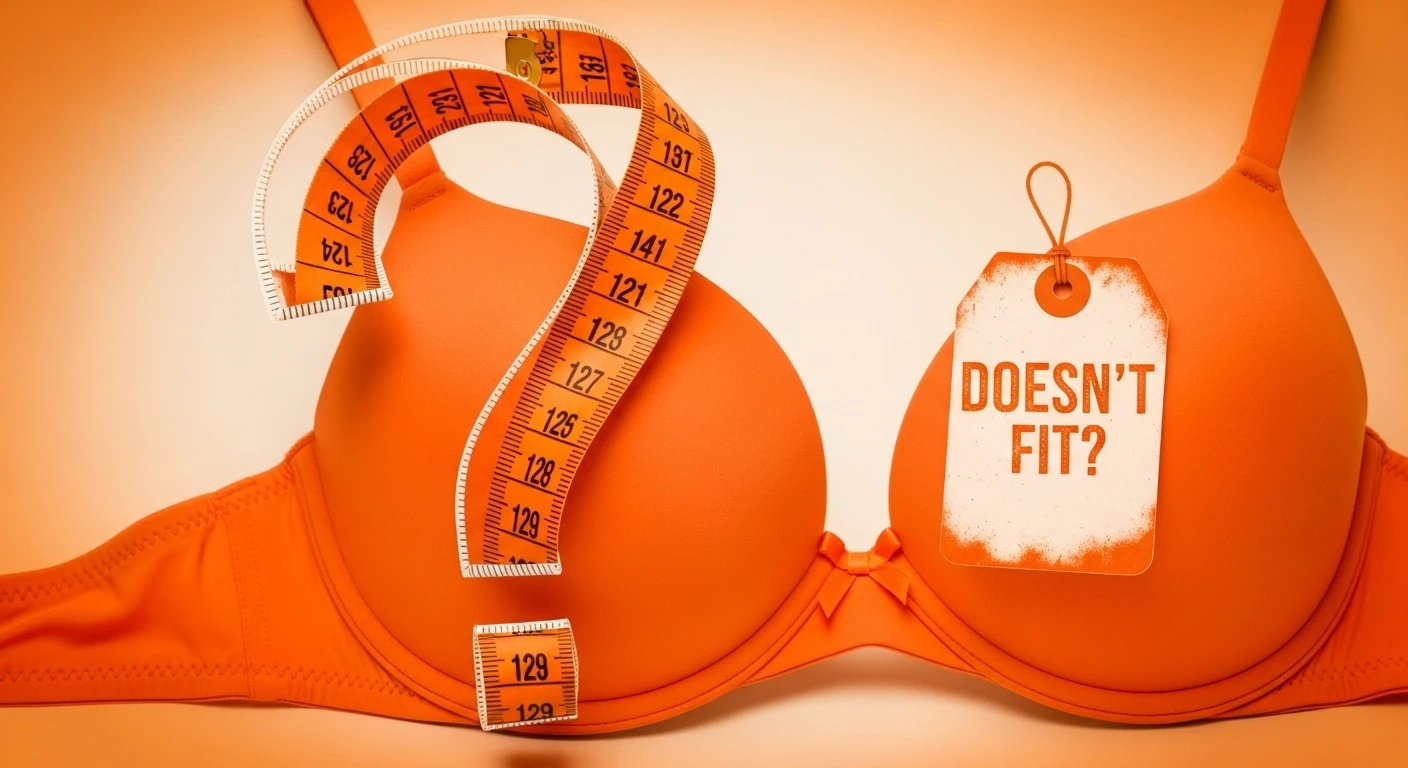
Most women are wearing the wrong bra size. Here is why — and exactly what to do about it.
Studies and fitting surveys conducted across multiple countries consistently find the same thing: the majority of women — estimates range from 70 to 85 percent — are wearing the wrong bra size. Not slightly wrong. Often dramatically wrong. Women wearing band sizes two or three numbers too large. Women wearing cup sizes far too small. Women whose bras are technically the "right" size but the wrong shape for their body entirely.
The result is not just discomfort — though there is plenty of that. An ill-fitting bra fails at its most basic job. It does not support. It does not contain. It creates visible problems under clothing. It causes physical pain in the shoulders, back, and ribcage. And because most women have been wearing the wrong size for years — often since they first started wearing bras — it has come to feel normal. The discomfort is so familiar it no longer registers as a problem.
This guide will change that. It explains the most common fit problems in plain language, tells you exactly what is causing each one, and gives you clear, actionable steps to fix them. By the end, you will know not just your correct size but how to evaluate fit on any bra before you buy it.
Why Getting Bra Fit Wrong Is So Common
Before getting into the problems and solutions, it is worth understanding why this problem is so widespread.
Sizing systems are confusing and inconsistent. Bra sizing uses a combination of a number (the band size) and a letter (the cup size), but cup size is not absolute — it is relative to the band. A 34C and a 36C are completely different cups. A 32D and a 38D share a letter but have nothing else in common. This relative sizing, called sister sizing, is widely misunderstood and rarely explained.
Most women are measured incorrectly. The traditional bra measurement method — adding 4 or 5 inches to the underbust measurement — was developed decades ago when bra fabrics had much less stretch. It systematically produces band sizes that are too large and cup sizes that are too small. Despite being outdated, this method is still used in many department stores and lingerie shops.
Bodies change constantly. Weight fluctuation, pregnancy, breastfeeding, hormonal changes, and aging all affect breast size and shape. A bra size that fitted correctly three years ago may be entirely wrong today, but most women continue wearing the same size they were measured at years ago.
Discomfort has been normalized. Many women believe that bras are supposed to be uncomfortable — that wires digging in or straps leaving marks are simply the price of wearing a bra. They are not. A correctly fitting bra should be comfortable enough that you largely forget you are wearing it.
Part One: The Fit Problems and What They Mean
Problem 1: The Band Rides Up at the Back
What it looks like: When you look in a mirror from the side, the back of your bra band is higher than the front — it has ridden up toward your shoulder blades rather than sitting horizontally around your ribcage.
What it means: Your band is too large. This is the single most common bra fit problem, and it is almost always caused by wearing a band size that is too big.
The band is the primary source of support in a bra — it should provide 80 to 90 percent of the total support. When the band is the right size, it sits firmly and horizontally around your ribcage. When it is too large, it has no tension to hold it in place, so the weight of the cups pulls the front down and the back rides up in response.
How to fix it: Go down one or two band sizes. If you are currently wearing a 36B, try a 34B first. You will likely need to go up in cup size at the same time to maintain the same cup volume — a 34C has the same cup volume as a 36B. This is sister sizing, explained in full in Part Two of this guide.
The new band should feel snug when fastened on the loosest hook. You should be able to slip two fingers underneath it, but no more. It should not move when you raise your arms.
Problem 2: The Band Feels Too Tight or Digs In
What it looks like: The band leaves deep marks on your skin. You feel pressure or discomfort around your ribcage. You feel relief when you take the bra off.
What it means: One of three things — and it is important to identify which one before simply going up in band size.
The first possibility is that the band genuinely is too small. If you sized down recently or are trying a new brand, the band may simply be too small for your ribcage.
The second and more common possibility is that the cup is too small, causing the underwire to press the entire bra structure inward. When the cup cannot contain the breast tissue properly, the wire sits against the breast rather than lying flat around it, creating the sensation of a too-tight band even when the band size itself is correct.
The third possibility is that the bra style is not right for your body — some underwire styles do not suit flatter or wider ribcages, and the wire shape creates pressure points regardless of size.
How to fix it: First, go up one cup size and try on the same band size again. If the tightness resolves, the cup was the issue. If it does not, try going up one band size — but remember to go down one cup size at the same time to maintain cup volume.
Problem 3: The Cups Wrinkle or Gap at the Top
What it looks like: There is extra fabric at the top of the cups. The fabric wrinkles or gapes, particularly when you lean forward. The cups are not filled out completely.
What it means: The cup is too large, the cup shape does not match your breast shape, or both.
If the cup wrinkles at the top but fits at the sides and bottom, the cup volume may simply be too large for your breast size. If the cup wrinkles specifically at the center top but fits around the sides, the issue is likely breast shape — you may have a less projected (shallower) breast shape that requires a different cup style rather than simply a smaller size.
How to fix it: First try going down one cup size. If the wrinkling reduces but other problems appear (wire sitting on breast tissue, for example), the cup size may be correct but the shape is wrong. Look for bras described as "full coverage" or with a shallower cup projection rather than plunge or demi styles.
Problem 4: The Cups Overflow or Spill Over
What it looks like: Breast tissue bulges over the top of the cup, over the sides, or pushes out under the wire. There is a visible double-breast effect under clothing. The top of the cup cuts into breast tissue.
What it means: The cup is too small. This is extremely common — partly because bra sizing at many mainstream retailers skews toward smaller cup letters, and partly because the outdated measurement method consistently underestimates cup size.
It is worth noting that overflow at the top of the cup and overflow at the side of the cup may indicate different problems. Overflow at the top usually means the cup volume is too small overall — go up in cup size. Overflow at the side, near the armpit, may mean the cup is too small but could also mean the cup style is wrong — a full coverage or side support style may help even in the correct cup size.
How to fix it: Go up one cup size. If overflow continues, go up another. Do not be surprised if you end up several cup sizes higher than you expected — this is extremely common, especially for women who have been measured using the old method.
Problem 5: The Wire Sits on Breast Tissue
What it looks like: The underwire does not lie flat against your ribcage. Instead, it sits on top of breast tissue — you can feel the wire pressing into the breast at the bottom or the sides.
What it means: The cup is too small. The wire in a correctly fitting bra should encircle the entire base of the breast, lying flat against the ribcage. When the cup is too small, the wire cannot travel far enough around the breast to reach the ribcage, so it rests on breast tissue instead.
This is one of the most uncomfortable fit problems and one of the most important to correct. A wire sitting on breast tissue causes pain, can restrict lymphatic circulation, and means the bra is providing essentially no support because the support structure is not in the right place.
How to fix it: Go up in cup size — sometimes by several sizes — until the wire lies completely flat against the ribcage and encircles the breast fully. You should not be able to feel the wire pressing on any breast tissue.
Problem 6: The Center Gore Does Not Lie Flat
What it looks like: The center piece of the bra — the small panel between the cups — does not lie flat against your sternum. It sits away from your body, tenting outward.
What it means: The cup is too small or the style does not suit the spacing of your breasts. When the cup is too small, the breast tissue pushes the cups apart, pulling the center gore away from the body. Alternatively, if you have widely spaced breasts, some bra styles simply will not have a center gore that lies flat on your anatomy, regardless of size.
How to fix it: First try going up in cup size. If the gore still does not lie flat after going up in cup size, look for styles described as "full coverage" or "wide set" which are cut to accommodate wider breast spacing. Balconette styles can also work well for wider-set breasts. Accept that not every style of bra will work on every body — finding the right style is as important as finding the right size.
Problem 7: The Straps Dig In or Leave Marks
What it looks like: The straps cut into your shoulders, leaving red marks or causing pain. You may have chronic shoulder or neck tension that you have never connected to your bra.
What it means: Most commonly, the band is too large. Remember — the band should provide 80 to 90 percent of support. When the band is too loose to do its job, the weight shifts to the straps, which dig into the shoulders to compensate. The straps are not designed to bear this load.
A secondary cause is straps that are simply adjusted too tightly — sometimes out of habit (trying to compensate for a too-loose band), sometimes by mistake.
Third possibility: the bra has thin, narrow straps that are not well-suited to a larger cup size. Bigger cups require broader straps with better weight distribution.
How to fix it: First, check your band size. If the band rides up at the back (see Problem 1), address that first — a correctly fitting band will usually resolve strap problems automatically. Loosen the straps slightly and see if the discomfort resolves. If you have larger cups, look for bras with wider straps that spread the load more effectively.
Problem 8: The Straps Fall Off the Shoulders
What it looks like: Bra straps constantly slip off your shoulders, no matter how much you tighten them.
What it means: Either the straps are placed too wide for your shoulder width, or the band is too loose. A too-loose band allows the entire bra to migrate and shift, causing straps to move out of position.
How to fix it: First, address band fit. If the band fits correctly but straps still fall, you need a different bra style. Racerback bras or styles with narrow-set straps work well for narrow or sloped shoulders. Some bras have adjustable strap placement — worth looking for if this is a persistent issue.
Problem 9: The Bra Looks or Feels Wrong Under Clothing
What it looks like: The bra is visible through clothing in unexpected ways — the wire outline shows, the cup edges create lines, or the bra creates visible bulk. Clothing sits oddly over the chest area.
What it means: Usually a combination of incorrect size and incorrect style for the particular clothing. Cups that are too small create the double-breast effect visible under fitted tops. Wires that sit on tissue instead of ribcage create visible outlines. A band that rides up creates a visible horizontal line across the back.
How to fix it: Correct the size first. Once the fit is right, consider bra style relative to your clothing — seamless bras for fitted tops, strapless styles for off-shoulder clothing, t-shirt bras with smooth molded cups for fine fabrics.
Part Two: Understanding Sister Sizing
Sister sizing is the concept that makes bra sizing make sense — and that most women have never been taught.
Cup size is not an absolute measurement. It is a ratio — the difference between your bust measurement and your band measurement. This means that as the band number changes, the same cup letter represents a completely different volume.
Here is a practical example. All of the following bras have the same cup volume:
- 30F
- 32E
- 34D
- 36C
- 38B
- 40A
They are sister sizes. Go up one band size, go down one cup letter. Go down one band size, go up one cup letter. The volume stays the same.
Why does this matter practically? Because when you change band size to fix a fit problem, you must adjust cup size accordingly to maintain the right cup volume. If you go from a 36C to a 34C to tighten the band, you are actually decreasing cup volume — which may cause overflow problems. The correct move is to go from 36C to 34D.
This is why so many women who try a smaller band size immediately say "it's too tight in the cups" and go back to the larger band. They did not adjust the cup letter, so the cup became too small. Understanding sister sizing prevents this mistake.
Part Three: How to Measure Yourself at Home
Commercial bra fitting in many stores still uses the outdated "add 4 inches" method. The modern measurement approach is more accurate and much simpler.
What You Need
- A soft fabric measuring tape
- A well-fitting (or reasonably fitting) bra to wear during measuring, or no bra for the underbust measurement
Step 1: Measure Your Underbust (Band Size)
Wrap the measuring tape snugly around your ribcage, directly under your bust. The tape should be horizontal all the way around — not dipping at the back. Breathe out naturally and take the measurement. Do not add any inches.
- If the measurement is an even number, that is your band size.
- If the measurement is an odd number, try both the number below and above (e.g., a 31-inch measurement means try both 30 and 32 bands).
Step 2: Measure Your Bust (Cup Size Starting Point)
Lean forward slightly at the waist so your breasts hang naturally away from your body. Wrap the measuring tape loosely around the fullest part of your bust — the tape should not compress the breast tissue. Take this measurement.
Step 3: Calculate the Difference
Subtract your underbust measurement from your bust measurement. The difference corresponds to a cup size:
| Difference Cup Size |
| 1 inch | A |
| 2 inches | B |
| 3 inches | C |
| 4 inches | D |
| 5 inches | DD / E |
| 6 inches | F |
| 7 inches | FF / G |
| 8 inches | G / H |
This gives you a starting size to work from. It is a starting point, not a final answer — fit must always be confirmed by trying the bra on and using the fit checklist below.
Part Four: The On-Body Fit Checklist
Measurements give you a starting size. The real confirmation of fit happens when the bra is on your body. Use this checklist every time you try on a bra.
The Scoop and Swoop First
Before evaluating fit, make sure all breast tissue is correctly positioned in the cups. Lean forward slightly, reach into each cup from the side and the top, and scoop all breast tissue forward into the cup. Any tissue that has migrated toward your armpit should be guided forward. Do this with every bra you try on. Many fit problems appear to resolve simply because the breast tissue is in the right position.
The Checklist
Band:
- [ ] The band sits horizontally all the way around — it does not ride up at the back
- [ ] The band is snug but not painful — you can fit two fingers underneath, no more
- [ ] The band does not move when you raise your arms above your head
- [ ] The bra is fastened on the loosest hook (there should be room to tighten as the bra stretches with wear)
Cups:
- [ ] All breast tissue is inside the cups — no overflow at the top, sides, or bottom
- [ ] The cups are smooth with no wrinkling or gaping
- [ ] The cup fabric lies flat against the breast without pulling away
Underwire (if applicable):
- [ ] The wire lies completely flat against the ribcage — it does not sit on any breast tissue
- [ ] The wire encircles the entire base of the breast
- [ ] The center gore lies flat against the sternum
Straps:
- [ ] The straps sit on the shoulders without digging in or leaving immediate marks
- [ ] The straps do not fall off the shoulders when you move your arms
- [ ] You can slip one finger under each strap comfortably
Overall:
- [ ] The bra feels comfortable when you move, reach, and breathe normally
- [ ] You cannot feel the wire pressing into breast tissue or ribcage uncomfortably
- [ ] The bra looks smooth under a fitted top
If all boxes are checked, the fit is correct. If any box is unchecked, use the problem guide in Part One to identify the adjustment needed.
Part Five: When Size Is Not the Only Answer — Bra Shapes for Different Bodies
Even in the correct size, not every bra style suits every breast shape and body type. Understanding your breast shape helps you choose styles that will fit well beyond just the size.
Full on top (more volume toward the top of the breast): Full coverage styles, balconette cuts. Avoid plunge styles which do not provide enough coverage at the top.
Full on bottom (more volume toward the lower portion of the breast): Plunge or demi styles work well. Avoid full coverage styles that may gap at the top.
Wide set (space between breasts): Plunge styles with a low center gore, balconette styles. Avoid styles with a high narrow center gore that will not lie flat.
Close set (breasts sit close together): Higher center gore styles, full coverage. Avoid plunge styles where the underwires may dig into the center chest.
Projected (breasts extend forward significantly): Deep cup styles with good projection. Avoid very flat or demi styles that cut across the breast without encircling it.
Soft or less projected tissue: Molded cup or padded styles provide structure. Soft cup styles may not give enough shape. Balconette and demi styles tend to work well.
Asymmetrical (one breast larger than the other): Fit to the larger side and use a bra insert in the smaller cup if needed. Some brands offer single-size cup inserts for this purpose.
Part Six: Making Your Bras Last
A correctly fitting bra is an investment. Caring for it properly extends its life significantly.
Wash by hand in cool water with a gentle detergent. Machine washing — even on a delicate cycle — stresses elastic, distorts underwire casings, and degrades padding far faster than hand washing. If you must machine wash, use a mesh lingerie bag and a cold gentle cycle only.
Never put a bra in the dryer. Heat destroys elastic and breaks down foam padding. Lay bras flat to dry or hang them from the center gore, not from the straps — hanging from the straps puts weight stress on the strap attachment points.
Rotate your bras. Wearing the same bra on consecutive days does not allow the elastic to recover fully. A rotation of at least three bras gives each one a rest day between wearings.
Always fasten on the loosest hook when new. Bra elastic stretches gradually with wear. Starting on the loosest hook gives you room to tighten as the bra ages, extending its useful life.
Replace bras when the fit changes — not on a fixed schedule. A bra that fits well can last 6 to 18 months with proper care depending on quality and frequency of wear. The signal to replace is fit, not time — when the band has stretched to the point where even the tightest hook cannot provide adequate support, or when the cups have deformed, it is time for a new bra.
A Final Word
The right bra does not pull, dig, overflow, gap, ride up, fall down, or hurt. It provides support you can feel but hardware you largely forget. It makes clothing sit better and your body feel better. And getting there is not as complicated as the lingerie industry sometimes makes it seem.
Go back to the beginning. Measure yourself with the modern method. Try on bras using the fit checklist. Understand that your size may be quite different from what you have been wearing — possibly significantly different — and that this is normal and fixable.
One well-fitting bra will teach you more about bra fit than years of wearing the wrong size. Find it, and let it recalibrate everything.
Quick Reference Summary
The most common fit problems and their fixes:
| Problem Most Likely Cause First Fix to Try |
| Band rides up at back | Band too large | Go down one band size, up one cup size |
| Band feels too tight | Cup too small, band too small, or wrong style | Go up one cup size first |
| Cups wrinkle / gap | Cup too large or wrong shape | Go down one cup size |
| Cups overflow | Cup too small | Go up one or more cup sizes |
| Wire on breast tissue | Cup too small | Go up in cup size until wire sits on ribcage |
| Center gore floats | Cup too small or wrong style for breast spacing | Go up in cup size; try wider-set styles |
| Straps dig in | Band too loose or straps too tight | Address band size first |
| Straps fall off | Shoulders too narrow or band too loose | Try racerback or narrow-strap styles |
The two rules that fix most problems:
- The band should be snug and horizontal — two fingers fit, no more.
- All breast tissue should be inside the cups — no overflow, no wrinkling.
Fit is everything. Size is just a starting point.
 english




 Automotive
 Gifts & Occasions
 Electronics & Computers
 Fashion & Apparel
 Beauty & Personal Care
 Home & Lifestyle
 Sports & Fitness
 Books, Movies & Music
 Baby & Kids